The NAHL: Raymond “Raymie” Skilton

Raymond “Raymie” Nelson Skilton typifies the fallen athlete hero. A star player from high school whose infamy grew as his fame departed. Perhaps, these simplified story lines belie a more complicated man. Or, maybe, the truth is as simple and direct as the man appeared to be.

Raymie’s illustrious hockey activities started as a Rindge Manual Training School goalie in 1905. He switched to defense in 1907. This position change was not a drastic change unlike the same shift in modern-era hockey. The early goalie was a normal player with no extra padding and strict rules. When the goalie got hurt, another player would simply step into the crease. If his later years reflect his youth, Raymie sought action and created it when missing. The static position of goalie probably clashed with Raymie’s innate personality.

Raymie shone as an early-era hockey “offensive defenseman”. Between the checking and scoring, Raymie led teams to victory. During the 1917-18 USNAHL season, he scored 11 goals in 11 games. During the height of his career, he typically averaged around a goal a game, which places him in contention with other forwards of his era.

Raymie did not limit himself to hockey, though. The Boston Globe named Raymie as Boston’s “Best All-Round Athlete” in 1916. The articled listed football, baseball, swimming, and horseback feats and accomplishments. Raymie played football and baseball in high school. At the time, ice hockey was a minor sport and played in the off-season between football and baseball. Raymie’s skill with horses possibly developed during his time with the Massachusetts Volunteer Militia (MVM). Raymie was actively engaged across a spectrum of sports until the early 1920s.

Raymie changed during the war years, but not because of war itself. Raymie seemed to run from war and leaving Massachusetts. Newspapers pondered the fate of local amateur sports if the MVM sallied forth for the Mexican Punitive Expedition. Raymie let his enlistment expire. When the U.S. Navy activated him, Raymie requested deferment due to economic hardship. The public figure of post-war Raymie struck a tarnished and exposed figure compared to pre-war Skilton.

Raymie’s hockey career ran into a brick wall after getting blacklisted by the Boston Athletic Association (BAA) in 1921. Raymie recruited three Canadians for the Shoe Trades club of the U.S. Amateur Hockey Association. Later, Irving Small revealed that amateur and Olympic athletes would be paid via cigarette tins. A practice fairly common in the New York amateur hockey scene in the 1900s and 10s. The ban was reversed before the start of the 1922 season, and he resumed playing.

This was only one of the many troubles experienced by Raymie Skilton in the post-war years. Court cases for verbally assaulting police officers, reckless driving and vehicular manslaughter assailed Raymie in the 20s. While the courts acquitted him, more legal troubles awaited him in the 30s.

Having lost his leather import business, he worked for a small company called Telenar Corporation in the 40s and 50s. Despite a seemingly quiet time during the 40s, the lawsuits and legal troubles renewed after he acquired patents related to a new metal production process called cold-flow processing. During the months long and very public legal process, he was even accused of offering the patents to Communists in a Mccarthy-era attack.

For all the commotion, Raymie Skilton passed away without much public notice on July 1, 1961. His passing caught the Boston Globe off-guard. They did not report it until February 1962. Eight months later! However, I don’t think the oversight diminishes his accomplishments as one of the first prominent, America-born Offensive Defensemen.
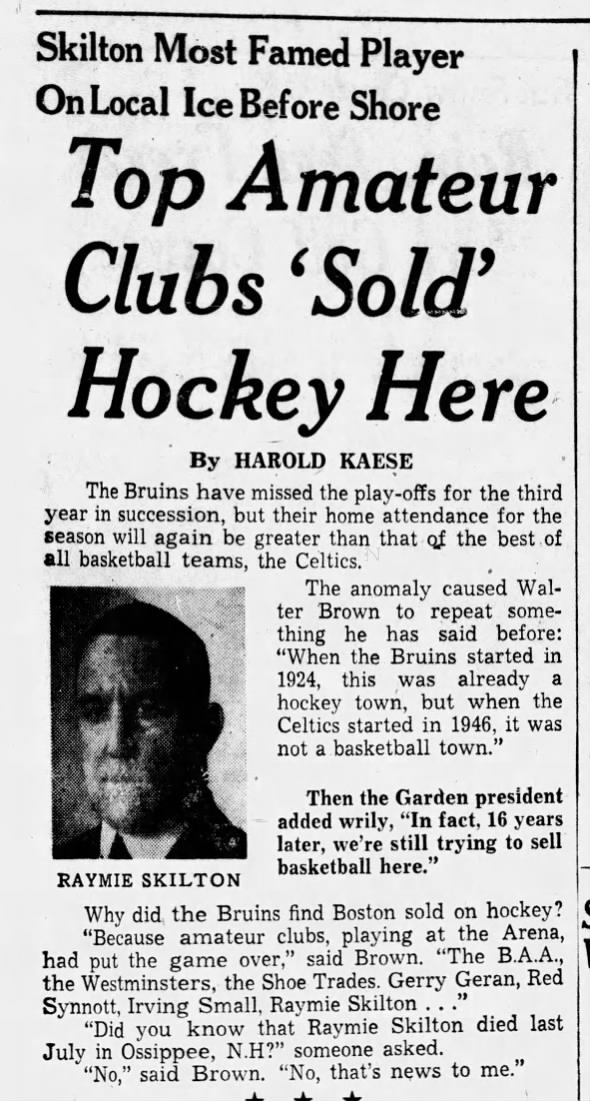
Sun, Feb 25, 1962 – 59 · The Boston Globe (Boston, Massachusetts) · Newspapers.com

The NAHL: Outline

As stated in the first post of the series, I intend to cover background material on key people involved in the United States’ National Amateur Hockey League (NAHL). For refresher, the NAHL only lasted one season, 1917-18 before morphing into the U.S. Amateur Hockey Association. It included four teams, the First Naval District, the Pittsburgh All-Stars (Yellow Jackets), the New York Wanderers and the Boston Arenas. The champions won a challenge cup, called the Fellowes Cup, who became the U.S. National Amateur Champions. The Fellowes Cup holder won the right to challenge Canada’s top amateur team who held the Art Ross Cup. In 1918, the holders of the cup were the Montreal Hochelaga.

I hope to cover one key character per week. I viewed these people through a tiered lens. The top tier covered key enablers, which included CAPT William Rush, George V. Brown, Roy Schooley and Cornelius Fellowes. These people enabled the formation of the NAHL. CAPT Rush probably hired George Brown to be his athletic director. Roy Schooley was well established in Pittsburgh. Cornelius Fellowes, entrenched in New York sports, sponsored the league’s challenge cup.

The next tier included dedicated coaches, which only covers Ralph Winsor. The rest of the teams had a player-coach or a manager-coach.

The last tier, which will start 29 or 30 June 2019, covers the key players. Players were chosen because of what they did on the ice, in the war or post-war. A few went on to play in one or both of the first two Olympic ice hockey games. Ralph Winsor coached the 1932 U.S. Men’s Olympic hockey team. All three teams won silver losing only to Canada.

To tease, expect, at a minimum, the following players to be covered in upcoming posts:

Raymie Skilton – USNRF, First Naval District
George “Chippy” Gaw – USNRF, First Naval District
Herb Drury – Pittsburgh All-Stars
Joe McCormick – Pittsburgh All-Stars
Mickey Roach – New York Wanderers
Frank Synott – Boston Arenas

These men lived storied lives. Their league faced many challenges including possible revocation as amateurs. After war over the ice and war on the ice, many faced war itself.

So, I hope you’ll continue reading about the men of wartime American hockey.

The NAHL: Alfred “Ralph” Winsor

With a multitude of accomplishments, The Boston Globe and others bequeathed the mantle of “Father of Modern Hockey” to “Ralph” Winsor Jr.  To summarize, many credit Ralph with the modern hockey stick, skate curve, and effective use of substitution (prior to the on-the-fly line changes of today). In his role as the first American-born college hockey coach, Ralph devised a new tactic specifically to counter Hobey Baker. Ralph shifted the point and cover point to force the forwards to the boards. The tactic was moderately successful in stopping Hobey. To help visualize this shift:

winsorHockey


Not only did Ralph modernize hockey, he supported his country in war and hockey.

Read More

The NAHL: Roy D. Schooley

Roy Dunlap Schooley, along with George Brown and Cornelius Fellowes Jr, completed the leadership triumvirate of the newly formed National Amateur Hockey League (NAHL). Like George, Roy came from more humble beginnings as a reporter in Welland, Ontario, Canada. In the early years of hockey, many reporters referreed games in order to get the story. As an independent reporter, Roy took advantage of this common practice. Roy, who apparently had a nose for a story, moved to Pittsburgh in 1901 and took this practice with him.

Outside of New York City and St. Paul, Pittsburgh attracted many Canadian hockey players. Tom Howard even played a few games there. In Pittsburgh, Roy gained renown as a referee. However, his primary means remained reporting. Working for the Pittsburgh Chronicle Telegraph, he focused on local politics. By 1917, Roy transitioned from a beat reporter to team owner/manager and embedded in the Pittsburgh political circles.

Between 1910 and 1930, Roy held many key city offices while maintaining the premier Pittsburgh hockey team. For example, Roy was the Chief Clerk of the Department of Public Works. These positions provided Roy the freedom to promote amateur hockey in Pittsburgh. In 1926, Roy transitioned the Pittsburgh Yellow Jackets from amateur to professional hockey. With this move, Roy destroyed the NAHL and signaled the end of prominence of amateur hockey.

Roy moved through Pittsburgh Republican circles. He leveraged his knowledge of sports promotion to get several mayors elected. They rewarded Roy with the position of City Treasurer. In 1930, scandal wormed through the Republican stronghold. The city treasury came up short and several transactions appeared to be suspicious. Additional investigation identified that city funds lacked critical backing as mandated by law. The federal probe targeted Roy and other key leaders. When prosecutors were ready in 1933, Roy died from a protracted illness, and the embezzlement case against him dropped.

Roy Schooley sought local, national, and international recognition. He found it in Pittsburgh. He brought in one of the strongest teams into a fledgling amateur league. He attracted talent possibly equal to Hobey Baker with Herb Drury. Without Roy Schooley, the NAHL might have been just another New England curioso instead of near national level spectacle.

Tue, Nov 14, 1933 – Page 9 · The Pittsburgh Press (Pittsburgh, Pennsylvania) · Newspapers.com

The NAHL: Cornelius Fellowes Jr.

A rebellious Cornelius Fellowes Jr. hid an unrestrained private life within a very boisterous public life. Descendant from colonial family lines, Cornelius entered into his father’s business, horse racing, possibly more from envy than following tradition. When Cornelius Sr. found out about the marriage to Nathalie Rogers, Senior disinherited Junior and cut off all support. As if in an American fairy tale, Nathalie, and by extension Cornelius Jr., inherited a quarter of million dollars from a deceased uncle in Paris. The unreported marriage, disavowal and windfall  were just the start of Cornelius’ tumultuous adult life.

Cornelius Fellowes Jr. was born to a horse racing magnate in Brooklyn, 1879. Cornelius came into adulthood with a true love, news story that was more about the senior socialite than the son. Written as a socialite intrigue piece, Cornelius quietly eloped with Nathalie Rogers, the daughter of a Philadelphia merchant, “over a year ago” as of June 1900. Between a secretive marriage and possibly acquiring goods under false pretense, Senior disowned Cornelius in June 1900. Fortunately, the death of an uncle depraves Cornelius Senior from punishing his son. True love trumps over money and arranged marriage. But, this isn’t the end of this story.

The article hints at an indecent indiscretion of Young Fellowes. While only hinted at, Cornelius probably got married around 1895 or 1896 at the age of 16 or 17. Nathalie would have been approximately 14 or 15, and quite possibly with their first child, William Fellowes. Although 16 is too young for 1890s New York, it is the legal age for Pennsylvania. When the story was published, Cornelius fathered three children with Nathalie, William, Gertrude, and Celia. The lack of documentation and abbreviating his name for the 1905 census demonstrates Cornelius’ efforts to separate his private life from his public profile.

To reinforce the concept, Cornelius’ divorce and remarriage lacked documentation just like his marriage to Nathalie. When reporters inquired Mademoiselle (mlle) Dazie about her marriage, she remarked that friends knew, but was surprised that the news had not leaked out before. The article from the Brooklyn Daily Eagle posted in March 1914. Unlike with Nathalie, no records seem to exist that indicate children between Cornelius and Dazie. Until about 1920, reporters detailed Cornelius Fellowes’ bankruptcies, various dealings and even a suspicious death. Afterwards, the news seem to focus solely on his sporting enterprises. When he passes in August 1957, a small blurb in the New York Times reminds us of how he failed to secure  the great horse “Man o’ War” by a hundred dollars.

Despite all the high profile drama, Cornelius Fellowes Jr. played a significant role in the National Amateur Hockey League. For starters, he sponsored the Fellowes Challenge Cup. That cup symbolized the U.S. national amateur hockey champions until 1926. He managed the St. Nicholas Rink from 1905 until 1920. Additionally, he ran the Wanderers of New York. As a rink and team owner, he was a hand behind the professional as amateurs in that role. Between Cornelius, George Brown, and Roy Schooley, they would forge a hockey powerhouse that would carry to two Olympic silver medals and rival even the Canadian teams.

Research notes:
– Cornelius Fellowes was written as Col. Fellowes on  the 1905 New York Census and  Fellows in some U.S. Government documents and newspaper accounts
– Nathalie Rogers was written as Natalie in some U.S. Government documents and newspaper accounts
– Celia was also written as Consuelo on Census documents
– Mlle Dazie falls prey to the multitude of spellings.

Sources:
1. Ancestry.com. Colonial Families of the USA, 1607-1775 [database on-line]. Lehi, UT, USA: Ancestry.com Operations, Inc., 2016. This collection was indexed by Ancestry World Archives Project contributors.
2. The Evening World, New York, New York  09 Jun 1900, Sat  •  Page 5
3. New York State Archives; Albany, New York; State Population Census Schedules, 1905; Election District: A.D. 07 E.D. 37; City: Brooklyn; County: Kings; Page: 63. Courtesy of Ancestry.com
4. The Brooklyn Daily Eagle Brooklyn, New York 21 Mar 1914, Sat  •  Page 16
5. Brian McFarlane, Golden Oldies: Stories of Hockey’s Heros, 2015
6.
Cornelius Fellowes, Sportsman, 78, Dies; Lost Bid for Man o’ War by $100 in 1918. (1957). New York Times (1923-Current File), p. 15.

The NAHL: CAPT William Rees Rush

At the start of 1917, Captain William Rees Rush commanded the Navy Yard in Boston and commandant of the First Naval District. He held the position since November, 1914. Although he officially retired on October 16, 1916, the Navy recalled him on October 17, 1916 to continue at Commander, Navy Yard, Boston. The Navy detached him from duty as Commander, First Naval District on February 7, 1918, but retained him as Commandant, Navy Yard. Finally, they retired Captain Rush on March 1919 upon being relieved of duty.  As Commandant, he oversaw many aspects of the Navy Yard and the transition to war. Besides reports of suspicious personnel or fires, he hired George Brown to be the athletic director for the First Naval District and promoted sports. For example, the Y.M.C.A built the first recreational facilities at the Navy Yard under his command. However, this is a small section of Captain Rush’s 43 year career in the United States Navy. And, it is not even the most significant time of his career.

Born in Philadelphia on September 19, 1857, William entered the U.S. Navy as a midshipman in June, 1872. This was not a Naval Academy midshipman appointment. William experienced a more “traditional” navy officer’s education. It lasted nearly ten years until his promotion to ensign in October, 1881.

Officer promotion worked completely different during Captain Rush’s service than now. Currently, promotions from ensign to lieutenant (junior grade) (LTJG) and LTJG to lieutenant (LT) are each two years with a minor review of the officer’s service record. William was promoted to LTJG in February, 1889 and promoted to LT in December, 1893. Ensign to LTJG was eight years and LTJG to LT was only four years. Plus, there were examinations. However, it is difficult to find much information without digging through the Bureau of Navigation or Personnel archives.

After several years at LT, William attended the Navy’s War College in 1900. This duty assignment prepared William for promotion to lieutenant commander (LCDR) in 1901. He also married Jane Pomroy Hare while attending the War College. There’s nearly a month of leave probably because Jane and William married in Hawaii.

In 1909, William was promoted to captain (CAPT). In December 1913, he attached to the Florida (BB-30). In April 1914, BB-30 and CAPT Rush were order to Vera Cruz as part of a expedition to evict General Victoriano Huerta from the Mexican presidency after a coup d’état. Between 21 and 22 April, CAPT Rush led a naval brigade (about 1,600 men) to take Vera Cruz. In about 24 hours, the city was captured with 17 dead and 65 wounded. In December, 1915, CAPT Rush was awarded the Medal of Honor.

After WWI, CAPT Rush and Jane Hare traveled Europe. Eventually, they landed up in Pallanza, Italy. CAPT Rush died on August 2, 1940, just after the fall of France. Jane Hare passes away in Switzerland on August 27, 1947.

As Commandant of the First Naval District, CAPT William Rush promoted sports and competition. It wasn’t limited to hockey, but football and other sports as well. He hired one of the best sports promoters of the era, and likely had a hand in acquiring talent, too. Whether for public relations or a competition against the Second Naval District or concern for the health of sailors, I doubt we’ll ever know. May be it was all three. Without Rush’s appointment of George Brown, we might not have had the first united states hockey league of national preeminence, the United States Amateur Hockey Association.

Sources:
1. https://www.history.navy.mil/research/library/online-reading-room/title-list-alphabetically/l/living-conditions-in-the-19th-century-us-navy.html
2. Naval Officer’s Service Record Abstract, National Archives, courtesy of Fold3 (https://www.fold3.com/image/581042150)
3. Confidential War Diaries (of the First Naval District) (1917-1918), National Archives, https://catalog.archives.gov/id/1137572
4. https://en.wikipedia.org/wiki/William_R._Rush
5. https://en.wikipedia.org/wiki/USS_William_R._Rush_(DD-714)
6. https://en.wikipedia.org/wiki/USS_Florida_(BB-30)
7. https://www.usni.org/magazines/naval-history-magazine/2014/march/take-veracruz-once
8. https://history.army.mil/html/moh/mohmex.html#RUSH

The CMPC in New York

As previously stated, the CMPC’s primary mission was to enforce conscription. In New York, the first head of station ensured that the media, and the American public, believed his mission was broader. The British Assistant Provost Marshal meant to apprehend fakers, deserters and other “undesirables”. That first head of station was Lt. Col Frederick Fraser Hunter, who arrived in March, 1918.

The British Assistant Provost Marshal (B.A.P.M) headquarters was located near Battery Park, New York City with 50 personnel assigned. This placed the headquarters well south of the BCMR’s main office on 681 fifth avenue, but within easy reach of the main recruiting office on 280 Broadway. Canada and Britian split funding for the B.A.P.M. Additionally, USA, Canada and Britian entered into a tri-party agreement on authorities. The B.A.P.M was the first foreign law enforcement authorized to operate in the United States. Moreso, the United States supported and assisted the B.A.P.M.

From various newspaper articles, The B.A.P.M prosecuted at least four cases. One case involved two Americans who volunteered for the Royal Canadian Air Corps. They were declared deserters when they returned to Viriginia after the dissolution of the Air Corps in 1916. (Note: The Air Corps was reconstituted in 1917.) However, most of the cases were fakers.

Fakers posed as British officers with great military deeds and attempted to cash large cheques from Canadian banks. Usually, the faker would get a free meal, a free night’s stay, and some of the cash. The newspapers ran a few stories about these fakers and how they were caught by the B.A.P.M.

As for Col. Hunter, he led a storied and controversial life. Born in 1876 in Dunham, Ontario, Canada, he traveled the world in service of the empire. Hunter earned distinction during his survey mission in India and during his time with the South Perisan Rifles. Because of his Canadian background, he was the B.A.P.M. until April, 1919 when most of Canada’s war aparatuses were dismantled.

In 1919, the B.A.P.M. transitioned from Canadian to British hands. Besides the name change to British Army Provost Marshal, the replacement head of mission became Col. Norman G. Thwaites. Oddly enough, his courtship and marriage to Elleanor Whitridge Greenough made significant news. Unfortunately, not much appears to have been written about the B.A.P.M. under his direction.

The CMPC office in New York requires more research. Considering LtCol Hunter traveled most of the eastern seaboard of the United States, a question lingers about his true purpose. Additionally, what was the effectiveness of the New York office. Exact numbers on prosecutions were not listed in the Report on enforcement of the Military Service Act (MSA). However, the report on the Overseas Mission explicitly called out the MSA enforcement numbers as unverifiable. As result, I am unable to confidently determine the effectiveness or exact mission of the B.A.P.M. and Lt Col Fraser Hunter.

To note, Col Fraser died in Dunham, Ontario in 1959. Itt appears he married a Kate Upper in New York around 1903. More of his story can be found in the book “Kipling’s Canadian: Colonel Fraser Hunter, MPP, maverick soldier surveyor in ‘the Great Game'”.

Read More

The British Canadian Recruiting Mission

The British Canadian Recruiting Mission (BCRM) operated under the British War Office (abbreviated WO or W.O. in personnel records). The War Office was also known as the British War Mission. The BCRM was created to recruit British subjects in the United States for service in the C.E.F. However, the BCRM was only one component of the War Office.

The BCRM spread across the U.S.A, but the focus is on New York City. Based upon a few sources, the BCRM in NYC consisted at least ten personnel with two primary offices. The following personnel were assigned or connected to the BCRM:

  • B.Gen Wilfred Arthur White. A British General associated with the Connaught Rangers
  • LtCol Cameron Alex Warren: Canadian. Chief Medical Examiner
  • LtCol Campbell Arthur Stuart: French-Canadian. Military Secretary. Connaught Rangers
  • Capt Paul FleetFord Sise: Canadian. Director of Recruiting. Hon. Major.
  • Capt Francis Chattan Stephens: Canadian.
  • Capt Alexander Cunningham Tweedie: Canadian.
  • Lt. Frederick Albert Gunther: British.
  • Lt Thomas Edward Allen: Irish
  • J.W. Woods: Canadian. Civilian. Director of Purchasing
  • George Algernon Trenholme: French-Canadian. Civilian. Audit and Finance

While there are two primary locations, some locations are still being validated. Here are the locations:

  • 681 Fifth Avenue: Suspected to be BCRM and War Office HQ.
  • 280 Broadway: BCRM Recruiting station
  • 511 Fifth Avenue: Unverified location
  • 120 Broadway: Unverified location. Possibly purchasing offices.
  • Vanderbilt Hotel: a location listed for Capt Paul SISE. Unverified association to BRMC

So, here’s the real teaser. The BCRM was home to a CMPC Assistant Provost Marshal (APM) who was in charge of about 50 personnel. I don’t think this included the Royal Flying Corps APM and three subordinates for NYC. There’s clearly more to this story. For example, there’s an interesting New York Times article from 1918 on the Provost Marshal office. However, this APM is in direct support to the BCRM with authorization to enforce the Military Service Act, 1917.

Sources:
1. Who’s Who in the British War Mission in the United States of America, 1917 (Google Book: https://tinyurl.com/y9ohlt8n)
2. Richard Holt (2015) “British Blood Calls British Blood The British-Canadian Recruiting Mission of 1917-1918,” Canadian Military History: Vol. 22: Iss. 1, Article 4. Available at: http://scholars.wlu.ca/cmh/vol22/iss1/4
3. Library Archive Canada CEF record for Cameron Alexander Warren (RG 150, Accession 1992-93/166, Box 10104 – 1): http://www.bac-lac.gc.ca/eng/discover/military-heritage/first-world-war/personnel-records/Pages/item.aspx?IdNumber=298860
4. Library Archive Canada CEF record for Campbell Arthur Stuart (RG 150, Accession 1992-93/166, Box 9393 – 20): http://www.bac-lac.gc.ca/eng/discover/military-heritage/first-world-war/personnel-records/Pages/item.aspx?IdNumber=256894
5. Library Archive Canada CEF record for Francis Chattan Stephens (RG 150, Accession 1992-93/166, Box 9272 – 22): http://www.bac-lac.gc.ca/eng/discover/military-heritage/first-world-war/personnel-records/Pages/item.aspx?IdNumber=250011
6. Library Archive Canada CEF record for Alex Cunningham Tweedie (RG 150, Accession 1992-93/166, Box 9855 – 10): http://www.bac-lac.gc.ca/eng/discover/military-heritage/first-world-war/personnel-records/Pages/item.aspx?IdNumber=282067
7. Library Archive Canada CEF record for Paul Fleetford Sise (RG 150, Accession 1992-93/166, Box 8952 – 28):http://www.bac-lac.gc.ca/eng/discover/military-heritage/first-world-war/personnel-records/Pages/item.aspx?IdNumber=232053
8. Expense of Assistance of Provost Marshal in New York to be divided between the British and Canadian Governments (RG24-C-1-a. Volume/box number: 1008. File number: HQ-54-21-23-116): http://www.bac-lac.gc.ca/eng/CollectionSearch/Pages/record.aspx?app=fonandcol&IdNumber=1886766

Additional Sources:
1. Caledonian Vol 18 (Google Book: https://tinyurl.com/ycemq8gy)

Royal Canadian Navy Police: Quick Note

In my last post, I didn’t include any information about the Royal Canadian Navy (RCN) Naval Police (N.P.)/Shore Patrol. While I found some information on MP Museum’s website, I wanted more detailed information and get at source documentation.

Anita Draper posted personal letters from Noah Draper. One letter dated 29 December, 1916, highlighted that the Naval Police had a censorship and/or Counter-Intelligence function.

A web site dedicated Canadian Military Police (NOTE: the redcap website) indicated that the RCN, likely during WWII, relied upon dockyard police, local civil authorities and shore patrol. MP Museum does back this up and provide more details on who had RCN policing functions. With associations with the Director of Naval Intelligence, Naval Provost Marshal and a mix of other, I think that gaining an understanding of the WWI RCN NP will be an arduous task.

Sources:
1. http://mpmuseum.org/rcn.html
2. http://www.anitamaedraper.com/author-memories/ww1-letters-home-dec-29-1916
3. WWII RCN Police information: http://home.mweb.co.za/re/redcap/canada.htm
4. Draper, Noah: https://www.bac-lac.gc.ca/eng/discover/military-heritage/royal-canadian-navy-1910-1941-ledger-sheets/Pages/item.aspx?IdNumber=12966&

Canadian Military Police: Organizational Structure

I like to understand the organizational relationships, both horizontally and vertically, of the subject. Besides, I thought this was a task that I had nearly completed. Little did I realize how convoluted and entangled the relationships were between the Police units (C.M.P.C., Dominion, R.N.W.M.P) and the ministries. Furthermore, some positions, like the Minister of Aviation, I haven’t been able to verify. With that, here is a look at the relationships between the Ministries and Policing elements of Canada and the Military Services Act, 1917.

Read More