The NAHL: John James O’hare Jr., esq.

John James O’hare Jr. maintained a sense of community through active engagement in alumni functions and public service. Born on 6 July, 1897, J.J. O’hare was one of the youngest members on the First Naval District hockey team. Like Raymie Skilton and other teammates, J.J. O’hare played multiple high school sports, including football (quarterback), baseball (1st base), and hockey (defense). During his time at English High School, J.J. earned the nicknames “Brick” (football) and “Red” (hockey), but, it was by “Brick” that he was known.

Brick graduated high school in April, 1917 and joined the Navy Reserves in September, 1917. He answered George Brown’s “call to sticks”. Ralph Winsor selected him for the team. This fortuitous event would lead to the formation of Boston University’s official hockey team.

Student movements tried twice between 1917 and 1922 to create a B.U. hockey team. The 1917-18 team played one game. Unfortunately, the war probably doomed this first attempt. The war absorbed much of the available sports talent. As a result, many colleges and amateur leagues decided against hosting an official team or championship series. East coast based hockey paused for the 1918-20 season. B.U. attempted a 1919-20 team but it only played two games. As a club team, it was likely hindered in securing games.

In 1920, B.U. reorganized its athletic association to include student leadership. Brick became its first vice president. Ever since taking the post, Brick attempted to get B.U. president Daniel Marsh to authorize an official hockey team. When Brick graduated B.U. in 1922, the seemingly ever-present George V. Brown also directed B.U.’s athletic association. With Brown’s backing, B.U. finally got an official hockey team for the 1922-23, and Brick would be its first coach.

Despite playing hockey since high school, Brick was not a good a coach. He got progressively worse over the course of his two years. His first season ended with 2 wins and 6 losses. Brick was known to “play the man”. He recounted the first time he played the MLB Hall of Fame Catcher Mickey Cochrane. He directed Cochrane to knock down George Owen every time [Owens] was on the ice. Several close games against skilled coaches like Ralph Winsor earned him a second season. Unfortunately, Brick finished with 1 win and 8 losses. “Chippie” Gaw replaced Brick for the 1924-25 season. For his effort, B.U. inducted John J. O’hare as an inaugural Hall of Fame member in 1959.

Brick graduated B.U. with a law degree. Bouncing around a few different law firms in the Boston area, Brick found his career in the Massachusetts Bay Transport Authority (MBTA) as a trial lawyer. In the public’s eye, his legal activities remained second to alumni support.

Brick played in alumni games and presided over alumni activities well into the 1960s. He participated in the English High School annual football and hockey games until the mid-30s. The Globe noted his alumni activities and charity work for B.U. until the 60s.

Brick remained a local man all his life. He lived in Jamaica Plain. He worked and schooled in Boston. He died in Framingham. A dedicated man with a strong sense of community.
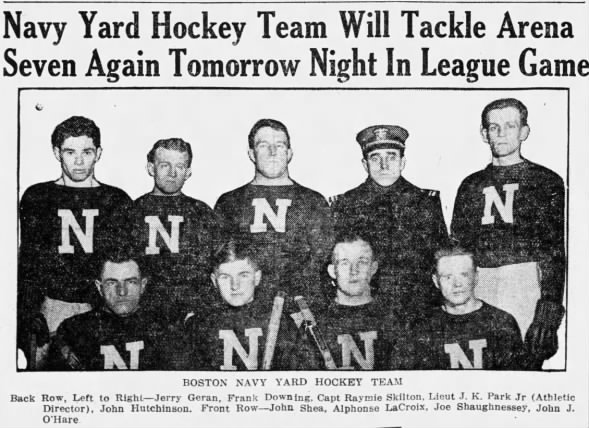
charlestown navy yard hockey teamcharlestown navy yard hockey team Tue, Feb 26, 1918 – 7 · The Boston Globe (Boston, Massachusetts) · Newspapers.comSources:
1. Boston University Hall of Fame.
2. Boston Terrier Hockey 1922-23, College Hockey News.
3. Boston Terrier Hockey 1923-24, College Hockey News.
4. J.J. O’hare Obituary. The Boston Globe, Boston, Massachusetts. 21 Nov 1981
5. Mickey Cochrane Obituary. The Boston Globe, Boston, Massachusetts, 10 Jan 1962
6. Other Boston Globe papers, courtesy of Newspapers.com.
The NAHL: Raymond “Raymie” Skilton

Raymond “Raymie” Nelson Skilton typifies the fallen athlete hero. A star player from high school whose infamy grew as his fame departed. Perhaps, these simplified story lines belie a more complicated man. Or, maybe, the truth is as simple and direct as the man appeared to be.

Raymie’s illustrious hockey activities started as a Rindge Manual Training School goalie in 1905. He switched to defense in 1907. This position change was not a drastic change unlike the same shift in modern-era hockey. The early goalie was a normal player with no extra padding and strict rules. When the goalie got hurt, another player would simply step into the crease. If his later years reflect his youth, Raymie sought action and created it when missing. The static position of goalie probably clashed with Raymie’s innate personality.

Raymie shone as an early-era hockey “offensive defenseman”. Between the checking and scoring, Raymie led teams to victory. During the 1917-18 USNAHL season, he scored 11 goals in 11 games. During the height of his career, he typically averaged around a goal a game, which places him in contention with other forwards of his era.

Raymie did not limit himself to hockey, though. The Boston Globe named Raymie as Boston’s “Best All-Round Athlete” in 1916. The articled listed football, baseball, swimming, and horseback feats and accomplishments. Raymie played football and baseball in high school. At the time, ice hockey was a minor sport and played in the off-season between football and baseball. Raymie’s skill with horses possibly developed during his time with the Massachusetts Volunteer Militia (MVM). Raymie was actively engaged across a spectrum of sports until the early 1920s.

Raymie changed during the war years, but not because of war itself. Raymie seemed to run from war and leaving Massachusetts. Newspapers pondered the fate of local amateur sports if the MVM sallied forth for the Mexican Punitive Expedition. Raymie let his enlistment expire. When the U.S. Navy activated him, Raymie requested deferment due to economic hardship. The public figure of post-war Raymie struck a tarnished and exposed figure compared to pre-war Skilton.

Raymie’s hockey career ran into a brick wall after getting blacklisted by the Boston Athletic Association (BAA) in 1921. Raymie recruited three Canadians for the Shoe Trades club of the U.S. Amateur Hockey Association. Later, Irving Small revealed that amateur and Olympic athletes would be paid via cigarette tins. A practice fairly common in the New York amateur hockey scene in the 1900s and 10s. The ban was reversed before the start of the 1922 season, and he resumed playing.

This was only one of the many troubles experienced by Raymie Skilton in the post-war years. Court cases for verbally assaulting police officers, reckless driving and vehicular manslaughter assailed Raymie in the 20s. While the courts acquitted him, more legal troubles awaited him in the 30s.

Having lost his leather import business, he worked for a small company called Telenar Corporation in the 40s and 50s. Despite a seemingly quiet time during the 40s, the lawsuits and legal troubles renewed after he acquired patents related to a new metal production process called cold-flow processing. During the months long and very public legal process, he was even accused of offering the patents to Communists in a Mccarthy-era attack.

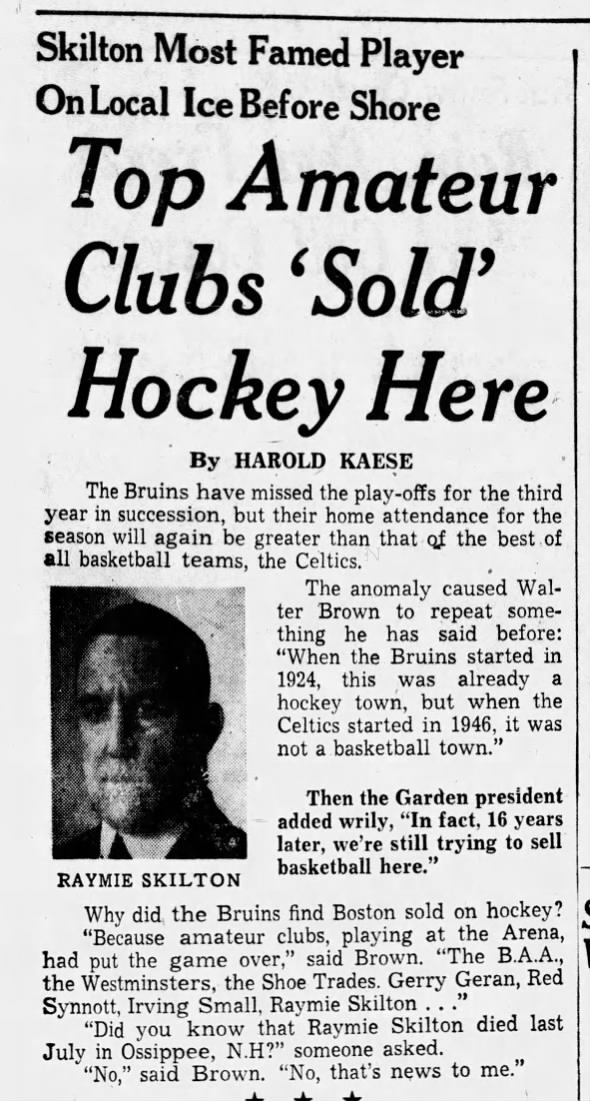
For all the commotion, Raymie Skilton passed away without much public notice on July 1, 1961. His passing caught the Boston Globe off-guard. They did not report it until February 1962. Eight months later! However, I don’t think the oversight diminishes his accomplishments as one of the first prominent, America-born Offensive Defensemen.

Sun, Feb 25, 1962 – 59 · The Boston Globe (Boston, Massachusetts) · Newspapers.com

The NAHL: Alfred “Ralph” Winsor

With a multitude of accomplishments, The Boston Globe and others bequeathed the mantle of “Father of Modern Hockey” to “Ralph” Winsor Jr.  To summarize, many credit Ralph with the modern hockey stick, skate curve, and effective use of substitution (prior to the on-the-fly line changes of today). In his role as the first American-born college hockey coach, Ralph devised a new tactic specifically to counter Hobey Baker. Ralph shifted the point and cover point to force the forwards to the boards. The tactic was moderately successful in stopping Hobey. To help visualize this shift:

winsorHockey


Not only did Ralph modernize hockey, he supported his country in war and hockey.

Read More

The NAHL: CAPT William Rees Rush

At the start of 1917, Captain William Rees Rush commanded the Navy Yard in Boston and commandant of the First Naval District. He held the position since November, 1914. Although he officially retired on October 16, 1916, the Navy recalled him on October 17, 1916 to continue at Commander, Navy Yard, Boston. The Navy detached him from duty as Commander, First Naval District on February 7, 1918, but retained him as Commandant, Navy Yard. Finally, they retired Captain Rush on March 1919 upon being relieved of duty.  As Commandant, he oversaw many aspects of the Navy Yard and the transition to war. Besides reports of suspicious personnel or fires, he hired George Brown to be the athletic director for the First Naval District and promoted sports. For example, the Y.M.C.A built the first recreational facilities at the Navy Yard under his command. However, this is a small section of Captain Rush’s 43 year career in the United States Navy. And, it is not even the most significant time of his career.

Born in Philadelphia on September 19, 1857, William entered the U.S. Navy as a midshipman in June, 1872. This was not a Naval Academy midshipman appointment. William experienced a more “traditional” navy officer’s education. It lasted nearly ten years until his promotion to ensign in October, 1881.

Officer promotion worked completely different during Captain Rush’s service than now. Currently, promotions from ensign to lieutenant (junior grade) (LTJG) and LTJG to lieutenant (LT) are each two years with a minor review of the officer’s service record. William was promoted to LTJG in February, 1889 and promoted to LT in December, 1893. Ensign to LTJG was eight years and LTJG to LT was only four years. Plus, there were examinations. However, it is difficult to find much information without digging through the Bureau of Navigation or Personnel archives.

After several years at LT, William attended the Navy’s War College in 1900. This duty assignment prepared William for promotion to lieutenant commander (LCDR) in 1901. He also married Jane Pomroy Hare while attending the War College. There’s nearly a month of leave probably because Jane and William married in Hawaii.

In 1909, William was promoted to captain (CAPT). In December 1913, he attached to the Florida (BB-30). In April 1914, BB-30 and CAPT Rush were order to Vera Cruz as part of a expedition to evict General Victoriano Huerta from the Mexican presidency after a coup d’état. Between 21 and 22 April, CAPT Rush led a naval brigade (about 1,600 men) to take Vera Cruz. In about 24 hours, the city was captured with 17 dead and 65 wounded. In December, 1915, CAPT Rush was awarded the Medal of Honor.

After WWI, CAPT Rush and Jane Hare traveled Europe. Eventually, they landed up in Pallanza, Italy. CAPT Rush died on August 2, 1940, just after the fall of France. Jane Hare passes away in Switzerland on August 27, 1947.

As Commandant of the First Naval District, CAPT William Rush promoted sports and competition. It wasn’t limited to hockey, but football and other sports as well. He hired one of the best sports promoters of the era, and likely had a hand in acquiring talent, too. Whether for public relations or a competition against the Second Naval District or concern for the health of sailors, I doubt we’ll ever know. May be it was all three. Without Rush’s appointment of George Brown, we might not have had the first united states hockey league of national preeminence, the United States Amateur Hockey Association.

Sources:
1. https://www.history.navy.mil/research/library/online-reading-room/title-list-alphabetically/l/living-conditions-in-the-19th-century-us-navy.html
2. Naval Officer’s Service Record Abstract, National Archives, courtesy of Fold3 (https://www.fold3.com/image/581042150)
3. Confidential War Diaries (of the First Naval District) (1917-1918), National Archives, https://catalog.archives.gov/id/1137572
4. https://en.wikipedia.org/wiki/William_R._Rush
5. https://en.wikipedia.org/wiki/USS_William_R._Rush_(DD-714)
6. https://en.wikipedia.org/wiki/USS_Florida_(BB-30)
7. https://www.usni.org/magazines/naval-history-magazine/2014/march/take-veracruz-once
8. https://history.army.mil/html/moh/mohmex.html#RUSH

The NAHL: George V. Brown

In late 1917, George V. Brown added a new role to his accomplished list, Athletic Director of the First Naval District. Prior to this, he held the same position of the Boston Athletic Association (BAA). With the BAA, he started every Boston Marathon except for the first two. During his era, BAA teams won championships. He promoted sports whenever he got the chance. George was such a fixture in the BAA and Boston sports that the BAA suspended or refocused operations during 1918.

It is hard to tell who used whom. The U.S. Navy leveraged George’s sports promotions to increase its popularity. Quite possibly, the First Naval District hoped to gain an advantage in the regular sports competitions against Second Naval District (Newport, Rhode Island) and others. For George, he became responsible for Navy sports across most of New England.

Following the war, George returned the BAA back to its normal sports operations. A long time member of the U.S. Olympic Committee, George built the U.S. Olympic men’s hockey team for the first Winter Olympics in 1924. (NOTE: Cornelius Fellowes created the first Olympic men’s hockey team in 1920.) It was a silver medal team consisting of Herb Drury and Alphonse La Croix.

George also experienced change in hockey from the amateur to the professional. While George supported professional hockey, George believed in the amateur spirit. He tried several times to establish a new amateur league in the Boston after the break up of the US Amateur Hockey Association. In 1932, the Boston Globe commented about George’s efforts to “breathe new life into the amateur hockey corpse.” Despite a potentially 150 registered clubs with the Amateur Athletics Union (AAU), amateur hockey would never regain a prominent role.

Fri, Dec 23, 1932 – 16 · The Boston Globe (Boston, Massachusetts) · Newspapers.com

Sources:
1. https://www.baa.org/
2. https://en.wikipedia.org/wiki/George_V._Brown
3. Boston Globe, December 23, 1932, courtesy of newspapers.com, https://www.newspapers.com/clip/31905965/
4. Los Angeles Times, March 8, 1931, courtesy of newspapers.com, https://www.newspapers.com/clip/29383315/

The NAHL: 1917, Hockey’s Year of Reckoning

On the eve of WWI, a medal of honor awardee, prominent sports personalities and the best hockeyists in the United States gathered on a world stage.  A legend had been building since the early 1900s starting in the New York City area. That legend, the legend of amateur hockey, came to fruition in 1917. The foundation for the next decade of hockey, both professional and amateur, were laid in that fateful year.

This blog over the next few months will provide brief biographies on key characters. Knowledge known and forgotten will be here in an attempt to provide a more complete picture of the hockeyists and their managers.

To note, amateur hockeyists can’t be paid for playing hockey. So, what were their jobs? Some times, they worked for a sporting goods store, like A. G. Spalding. Other times, they worked as car mechanics. And, as Brian McFarlane discovered, their work really was hockey and not lacing footballs at Spalding [1].

Getting back to the main topic, many will hopefully recognize the key players. From Boston, George V. Brown, Raymie Skilton and Frank Synott will be documented. From the US Navy, CAPT. William R. Rush, who was awarded the Medal of Honor for actions at Veracruz [2], plays a role. From Pittsburgh, Roy Schooley, Herbert Drury and the McCormick brothers drive action. Finally, New York’s Mickey Roach and “Duke” Wellington will be outlined. And, yes, Mickey Roach used be a Bostonian.

1917-18 season was a disruptive season for hockey. The creation of the National Hockey League, the infamous Montreal Arena fire [3], and the politics of amateur vs professional hockey that built to a crescendo in that season. The larger than life personalities, the hockeyists and the organizations all vying for control of the final outcome. But, first, we need to know who the entities are, and I hope you enjoy the journey.

Sources:
1. https://www.amazon.com/Golden-Oldies-Stories-Hockeys-Heroes/dp/1770412506
2. https://en.wikipedia.org/wiki/William_R._Rush
3. https://en.wikipedia.org/wiki/Montreal_Arena

Interlude: Winnipeg’s Forgotten Hockey Royalty, heir apparent Thomas Henry Howard

Despite being a first son of hockey, Thomas Henry Howard left surprisingly few markers resulting in a confusing trail across the ledgers of history. Born in Winnipeg, Manitoba, he really grew up in Brooklyn. As a result, Tom Jr. was actually more of Brooklynite than a Winnipegger. When Canadian and American WW1 demands threatened to ensnarl the Howards, Tom chose his fate by joining the United States Navy Reserve Force. While in the USNRF, Tom played hockey for Charlestown Navy Yard in Boston. In all the numerous teams, leagues, and travel, Tom wins his own hockey championship in the California Cal-Pro league in 1930 with the Shell Oil Tigers. Unfortunately, few trail markers remain after 1930 until his death in 1971. Regardless of how his trail meandered, he exemplified, “Family above all.”

Tom Jr. was raised at the table of winter sports. Tom Sr. won the Stanley Cup and reinvented himself in New York and Pittsburgh. Kathleen taught skating in Winnipeg and New York. She possibly taught young Jack how to speed skate. Not to mention, Winnipeg newspaper noted her gracefulness at various winter galas of her youth. But, Tom Jr. seemed to desire a more subdued life.

In many respects, Tom’s father hints at managing his sons like hockey players. Tom Jr. appears to start referring during the 1912-1913 season. Then, Tom moves to playing in the 1913-1914 season. However, news coverage seems to increase when Jack matures into amateur hockey by 1916. At this time, everyone is reading about WWI, and the Howards are still Canadian and subjects of the King of England.

Looking at the available facts, Tom joined the USNRF in Newport, Rhode Island in part due to patriotic pride for the United States. Additionally, other reasons may have influenced Tom Jr’s and Jack’s decisions to join the USNRF. Regardless of the motivation, Tom played in the USN hockey league for the Newport (R.I.) and Charlestown (Boston) Navy Yards. The US Navy trained Tom to play with mines. Tom and his brother, Jack, was assigned to the U.S.S. Canandaigua. They possibly particpated in the North Sea mine barrage. Whether they went with the fleet, Tom referred a Brookleny high school hockey game on 11 Jan, 1919.

After the death of his brother Jack in Dec 1919, Tom moved to California and married Natalie Matthews. Listing a California home address, Tom Jr. continued to play for his father’s teams on the East Coast from 1920 until 1924. During the late-twenties, he played for a variety of teams until landing on the 1930 Shell Oil Tigers team. Under Ernie Miller, the Shell Oil Tigers team beat the Vancouver Ballards to secure the CalPro championship. In 1949, Los Angeles Monarchs honored Tom Howard Jr and four others for bringing hockey to California. All the while, Tom and Natalie ensured the care of their parents.

From census records, Natalie’s father and then Tom’s parents lived with them in California. Natalie’s father moved from New York to be recorded in a 1920 California Census. When the next census happened in 1930, Tom’s parents, Tom Sr. and Kathleen, had moved in. From all the travels between New York and California, Tom Jr. appears to have supported his family’s decisions and supported the decisions of the family he married. As a result, it appears that he believed in family above all else.

the 1949’s tribute is really the last easy marker that Tom and Natalie Howard leave. A phone book entry here or may be a property records there. Tom died in Denver, Co. in 1971 and Natalie died in June of 1986. They died childless. Thus, with their deaths, ended the line of hockey greats.

Sources:
1. Manitoba Vital Statistics Agency, Birth Record: 1894-002467, http://vitalstats.gov.mb.ca/Query.php, last accessed 12 Aug 2018
2. The New York Times, Sunday, January 26, 1913 pg 69, courtesy of newspapers.com
3. Hartford Courant Thursday, March 5, 1914 pg 16, courtesy of newspapers.com
4. https://en.wikipedia.org/wiki/USS_Canandaigua_(ID-1694)
5. https://en.wikipedia.org/wiki/North_Sea_Mine_Barrage
6. Brooklyn Eagle, Saturday, January 11, 1919, pg 8, courtesy of newspapers.com
7. “California, County Marriages, 1850-1952,” database with images, FamilySearch (https://familysearch.org/ark:/61903/1:1:K8FB-YBP : 8 December 2017), Thomas Henry Howard and Natalie Matthews, 19 May 1921; citing Los Angeles, California, United States, county courthouses, California; FHL microfilm 2,074,267.
8. San Bernardino County Sun (California), Wednesday, January 16, 1924, pg 9, courtesy of newspapers.com
9. Los Angeles Times, February 26, 1949, courtesy of ProQuest.
10. “United States Social Security Death Index,” database, FamilySearch (https://familysearch.org/ark:/61903/1:1:JTHC-HM7 : 19 May 2014), Thomas Howard, Nov 1977; citing U.S. Social Security Administration, Death Master File, database (Alexandria, Virginia: National Technical Information Service, ongoing).
11. “United States Social Security Death Index,” database, FamilySearch (https://familysearch.org/ark:/61903/1:1:J1B8-5YD : 20 May 2014), Natalie Howard, Mar 1987; citing U.S. Social Security Administration, Death Master File, database (Alexandria, Virginia: National Technical Information Service, ongoing).

Other Sources:

http://www.squareone.org/PolarPalace/palais.html

Interlude: Winnipeg’s Forgotten Hockey Royalty, “Young Prince” Jack

John Frederick Howard, born in Dec 1896, was probably too young to remember much about Winnipeg before the Howard’s moved to New York. However, Canada, and winter sports, never left him. He was the youngest child of hockey’s first royal family, after all.

John, often referred to as “Jack”, gained some minor fame for speed skating at St. Nicholas Rink in 1912. A competition of skill and speed between Jack and the Gerschel (or Gershel) brothers, Arthur and Stanley, from Public School 166. Unfortunately, Jack’s skating exploits don’t appear to make news until 1917. Jack may have gone to Public School 155 or 153 and Manual, now known as John Jay. So, more records may be available from “The Prospect”, Manual’s Yearbook.

In 1917, Jack joins “The Hockey Club” along with his older brother Tom Howard, Jr. The Hockey Club was one of the four amateur teams in New York’s Metropolitan League. The winner would face the winner of Boston’s amateur league. Ultimately, the Hockey Club lost the 1917 season with 2 Wins – 4 Losses. Jack played in four games with three goals and no penalty minutes. Penalties appears to be one area where Jack did not follow his brother.

After the fateful season for the Hockey Club, Jack participated in an event sponsored by the Canadian Club of New York. The event was a charity drive for the Lady Drummond Hospital fund for Canadian soldiers. Activities at the event included figure skating. But, the highlight was the hockey game between the All-Stars and the Crescent. The event took place on March 21, 1917, prior to the United States joining the war.  The entire Howard family participated in some way, and Jack’s role was Goal Umpire. The event netted $502.

By October 1917, Jack enlisted in the Navy Reserves along with his brother. They both played on the Newport Navy Yard team in the US Navy Hockey League (USNHL), which played with other amateur leagues with approval from the Amateur Athletic Union (A.A.U.). Because of the approval of the A.A.U., USNHL players had full amateur status like their Canadian cousins.

Retaining amateur status for amateur hockey players who enlisted caused much debate in Canada. Amateur hockey players, moreso than other amateur sportspeople, lead dual lives. They play hockey at night and work by day. However, that work can’t pay to play, like hockey stick endorsement. They can be hockey coaches and write books. Tom”Attie” Howard landed in some hot water with the A.A.U. over his stick endorsement. Additionally, amateur hockey was viewed as the future. In a way, maintaining status was critical. The ruling handed down as military (officer and enlisted) who were amateur hockey players were allowed to keep their amateur status.

By initial accounts, Jack’s time with Newport Naval Reserves  hockey team resulted in two games and six goals. However, this is not a complete picture of the 1918 season. Jack was involved in a brawl between Charleston Navy Yard and New York Wanders’ Bill McGill. Jack, like his father who also participated in the brawl, were spectators.

Jack tragecally died after a car accident in Dec 1919. He was riding on the toolbox of Tom’s car when it was hit. Jack got up after the accident but apparently had massive internal injuries. They buried him on Christmas Eve, 1919. Jack born a hockey player; died as an insurance rep.

It’s not clear, but Jack’s death likely had a significant impact on his family. Shortly after, Press coverage of the Howard’s drastically reduces even from “home town” papers like Brooklyn Daily Eagle. Tom Jr. moves to California. While Mrs. Howard vansishes from nearly eve. I’m sure that part of the reason was the changing nature of hockey from amateur to professional and seven to six man. 1919 marks a changing in old guard of hockey.

John's deathJohn’s death Mon, Dec 22, 1919 – Page 3 · The Brooklyn Daily Eagle (Brooklyn, New York) · Newspapers.com

*NOTE: Jack is a common nickname for John in the United States. Other famous John’s named Jack include John F. Kennedy (35th President), John Lemmon (Actor), and John Lambert (NFL).
*NOTE: John Jay High School on 7th Ave was dismantled in 2004.
*NOTE: The Canadian Club of New York merged with another Canadian Society. The merged entity is called the Canadian Association of New York.
Read More

Interlude: Winnipeg’s Forgotten Hockey Royalty, “Queen” Kathleen Howard

While many aspects remain in mystery, Kathleen Howard’s advocacy for women’s hockey is unquestionable. Her abilities and circumstances paved a way for to become the United States first female hockey coach.

A Winnipeg native, she was born Kathleen Cronn or Crown in 1874. Prior to her marriage, she taught ice skating and participated in various Winnipeg Carnivals*. On May 13, 1893, she married Tom Howard, which started the “first family” of hockey. The family was complete with the birth of their two boys, Tom Jr. and John “Jack”. When they moved to Brooklyn in 1900, she brought hockey with her, and specifically for women.

Kathleen’s advocacy sprang to life in 1917 with the pronouncement, “Hockey for Women is not a Novelty.” While women played hockey in the United States during the “teens”, she noted that New York City women seemed to have forgotten about hockey. She also penned an article on women’s hockey for Spalding’s Official Ice Hockey Guide 1917, which Tom Howard edited.

Kathleen howard on hockey
Kathleen howard on hockey Thu, Feb 8, 1917 – Page 22 · The Brooklyn Daily Eagle (Brooklyn, New York) · Newspapers.com

She coached St. Nick’s women’s teams for at least two seasons, 1916-17 and 1917-18. In the 1916-1917 season, she took over for her husband in December, 1916. In 1918, she arranged a charity hockey match with Boston to help the employees after the Brooklyn Ice Palace was ordered closed. Not to say that women’s hockey died after 1918. As a matter of fact, women’s hockey enjoyed great success through the 1920s and 1930s. However, Kathleen seems to drop out of the news after 1918.

Some of this may be due to imperfect records and inconsistent reporting. For example, Manitoba lists three birth certificates for two boys, 2 for Thomas and 1 for John. Each certificate has a different name including an incorrect last name, Cronner. The Winnipeg Tribune constantly reports her last name as “Cronn” whereas government records lists “Crown”. After getting married, she is almost exclusively referred to as “Mrs. Tom Howard” or a variation thereof. As a result, a shroud of mystery wraps Kathleen. In reality, the biggest reason is due to what happened to Jack in 1919.

Somewhere around 1927, She and Tom move to California to live with their son, Tom Jr. She outlived her husband, who dies in November 1945. However, her own death is as ellusive as her legacy.

Her greatest feat wasn’t getting married to a star hockey player and coach. It wasn’t raising two upcoming stars of the amateur hockey world. Her greatest feat was being the first woman to coach hockey in the United States, and quite possibly Canada, too. Of course, Kathleen may disagree and say that seeing women in professional hockey was her greatest legacy.

*Note: Carnival events included hockey, ice skating, curling, and dressing up. Kathleen was noted for her costumes in 1891 (gypsy queen) and 1892 (faerie).

Read More

Interlude: Winnipeg’s Forgotten Hockey Royalty, “King” Attie Howard

By the end of 1930, Thomas Atcheson “Attie” Howard became one of hockey’s most important forgotten legends. During his time in the limelight, hockey drastically changed from a predominantly amateur sport to a self-sustaining professional entity. Additionally, game play drastically changed. Approved rule changes included multiple substitutions and reduction to six players on the ice. With such a storied life, a simple posting can only highlight a few major events and aspects of hockey’s King.

Thomas Howard was player, coach, and fan of hockey. Although Tom played in college, he is better known as a Winnipeg Victoria Forward. His playing career peaked with winning the Stanley Cup. Although seemingly acquired by St. Paul hockey club in 1899, Tom signed a contract to coach at Yale.

In 1900, Tom started his coaching career. In a professional capacity, Tom coached at Yale for ten years, Columbia University, Yale, Dean of Hockey at Jamaica High School,  and was possibly considered for the general manager role for the New York Americans. However, it appears Tom’s love was always amateur hockey and returned to coach the sport time and time again.

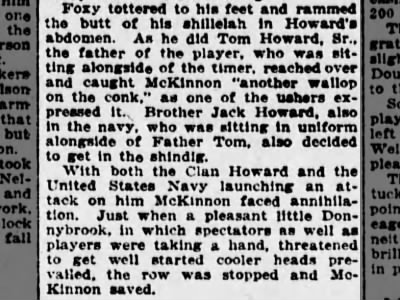
Tom wasn’t just a player. He wasn’t just a coach. He was a fan of the game, especially when his sons played. Both of his sons joined the Navy Reserve and played for the Boston Yard team. Well, an account of a game between The Wanderers (of New York) and the Boston Yard Team highlighted how hockey was a family affair, even if they were in the stands.

Hockey fights are family affairs for the HowardsHockey fights are family affairs for the Howards Tue, Feb 19, 1918 – Page 15 · New York Herald (New York, New York) · Newspapers.com

For each major change in hockey in the teens and twenties, people consulte Tom or his Almanac. Whether it was the transition from seven to six man squads or amateur over pros, newspapers sought Tom’s opinion. Additionally, Tom supported his wife as she coached the St. Nicholas Blues, a women’s hockey team.

Tom retires around 1927 and moves to Los Angeles with his son, Tom Jr. The last note in a long, storied life came from The Winnipeg Tribune:

Toms obitToms obit Fri, Nov 30, 1945 – Page 5 · The Winnipeg Tribune (Winnipeg, Manitoba, Canada) · Newspapers.com

Tom’s Wife, Kathleen, lived on until 1967. Tom’s kids, well, more on them later because Tom’s story doesn’t end here.