The NAHL: Raymond “Raymie” Skilton

Raymond “Raymie” Nelson Skilton typifies the fallen athlete hero. A star player from high school whose infamy grew as his fame departed. Perhaps, these simplified story lines belie a more complicated man. Or, maybe, the truth is as simple and direct as the man appeared to be.

Raymie’s illustrious hockey activities started as a Rindge Manual Training School goalie in 1905. He switched to defense in 1907. This position change was not a drastic change unlike the same shift in modern-era hockey. The early goalie was a normal player with no extra padding and strict rules. When the goalie got hurt, another player would simply step into the crease. If his later years reflect his youth, Raymie sought action and created it when missing. The static position of goalie probably clashed with Raymie’s innate personality.

Raymie shone as an early-era hockey “offensive defenseman”. Between the checking and scoring, Raymie led teams to victory. During the 1917-18 USNAHL season, he scored 11 goals in 11 games. During the height of his career, he typically averaged around a goal a game, which places him in contention with other forwards of his era.

Raymie did not limit himself to hockey, though. The Boston Globe named Raymie as Boston’s “Best All-Round Athlete” in 1916. The articled listed football, baseball, swimming, and horseback feats and accomplishments. Raymie played football and baseball in high school. At the time, ice hockey was a minor sport and played in the off-season between football and baseball. Raymie’s skill with horses possibly developed during his time with the Massachusetts Volunteer Militia (MVM). Raymie was actively engaged across a spectrum of sports until the early 1920s.

Raymie changed during the war years, but not because of war itself. Raymie seemed to run from war and leaving Massachusetts. Newspapers pondered the fate of local amateur sports if the MVM sallied forth for the Mexican Punitive Expedition. Raymie let his enlistment expire. When the U.S. Navy activated him, Raymie requested deferment due to economic hardship. The public figure of post-war Raymie struck a tarnished and exposed figure compared to pre-war Skilton.

Raymie’s hockey career ran into a brick wall after getting blacklisted by the Boston Athletic Association (BAA) in 1921. Raymie recruited three Canadians for the Shoe Trades club of the U.S. Amateur Hockey Association. Later, Irving Small revealed that amateur and Olympic athletes would be paid via cigarette tins. A practice fairly common in the New York amateur hockey scene in the 1900s and 10s. The ban was reversed before the start of the 1922 season, and he resumed playing.

This was only one of the many troubles experienced by Raymie Skilton in the post-war years. Court cases for verbally assaulting police officers, reckless driving and vehicular manslaughter assailed Raymie in the 20s. While the courts acquitted him, more legal troubles awaited him in the 30s.

Having lost his leather import business, he worked for a small company called Telenar Corporation in the 40s and 50s. Despite a seemingly quiet time during the 40s, the lawsuits and legal troubles renewed after he acquired patents related to a new metal production process called cold-flow processing. During the months long and very public legal process, he was even accused of offering the patents to Communists in a Mccarthy-era attack.

For all the commotion, Raymie Skilton passed away without much public notice on July 1, 1961. His passing caught the Boston Globe off-guard. They did not report it until February 1962. Eight months later! However, I don’t think the oversight diminishes his accomplishments as one of the first prominent, America-born Offensive Defensemen.
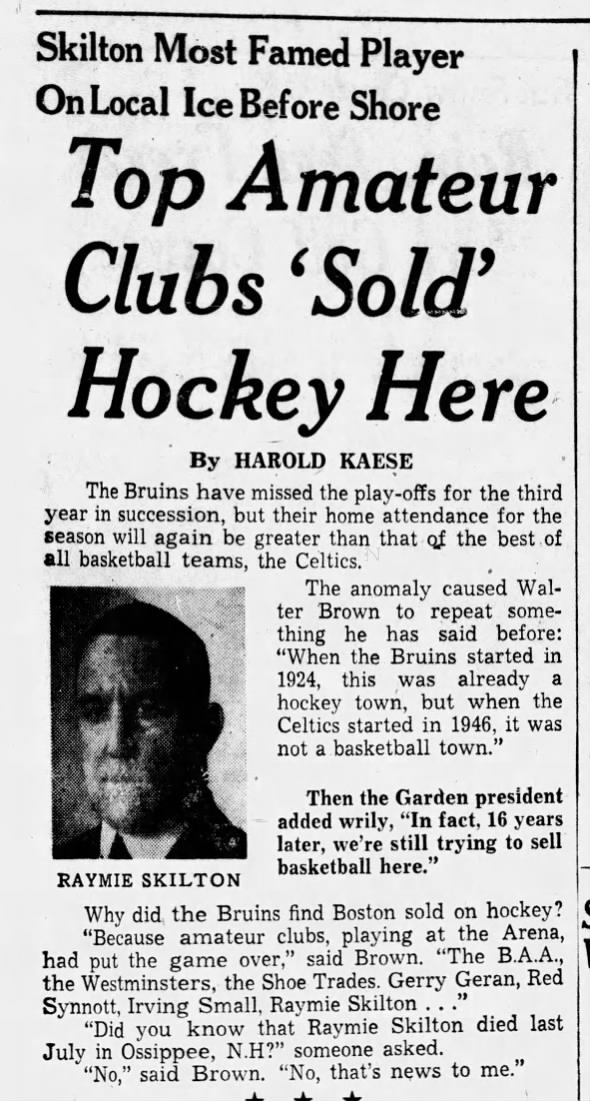
Sun, Feb 25, 1962 – 59 · The Boston Globe (Boston, Massachusetts) · Newspapers.com

The NAHL: Alfred “Ralph” Winsor

With a multitude of accomplishments, The Boston Globe and others bequeathed the mantle of “Father of Modern Hockey” to “Ralph” Winsor Jr.  To summarize, many credit Ralph with the modern hockey stick, skate curve, and effective use of substitution (prior to the on-the-fly line changes of today). In his role as the first American-born college hockey coach, Ralph devised a new tactic specifically to counter Hobey Baker. Ralph shifted the point and cover point to force the forwards to the boards. The tactic was moderately successful in stopping Hobey. To help visualize this shift:

winsorHockey


Not only did Ralph modernize hockey, he supported his country in war and hockey.

Read More

The NAHL: CAPT William Rees Rush

At the start of 1917, Captain William Rees Rush commanded the Navy Yard in Boston and commandant of the First Naval District. He held the position since November, 1914. Although he officially retired on October 16, 1916, the Navy recalled him on October 17, 1916 to continue at Commander, Navy Yard, Boston. The Navy detached him from duty as Commander, First Naval District on February 7, 1918, but retained him as Commandant, Navy Yard. Finally, they retired Captain Rush on March 1919 upon being relieved of duty.  As Commandant, he oversaw many aspects of the Navy Yard and the transition to war. Besides reports of suspicious personnel or fires, he hired George Brown to be the athletic director for the First Naval District and promoted sports. For example, the Y.M.C.A built the first recreational facilities at the Navy Yard under his command. However, this is a small section of Captain Rush’s 43 year career in the United States Navy. And, it is not even the most significant time of his career.

Born in Philadelphia on September 19, 1857, William entered the U.S. Navy as a midshipman in June, 1872. This was not a Naval Academy midshipman appointment. William experienced a more “traditional” navy officer’s education. It lasted nearly ten years until his promotion to ensign in October, 1881.

Officer promotion worked completely different during Captain Rush’s service than now. Currently, promotions from ensign to lieutenant (junior grade) (LTJG) and LTJG to lieutenant (LT) are each two years with a minor review of the officer’s service record. William was promoted to LTJG in February, 1889 and promoted to LT in December, 1893. Ensign to LTJG was eight years and LTJG to LT was only four years. Plus, there were examinations. However, it is difficult to find much information without digging through the Bureau of Navigation or Personnel archives.

After several years at LT, William attended the Navy’s War College in 1900. This duty assignment prepared William for promotion to lieutenant commander (LCDR) in 1901. He also married Jane Pomroy Hare while attending the War College. There’s nearly a month of leave probably because Jane and William married in Hawaii.

In 1909, William was promoted to captain (CAPT). In December 1913, he attached to the Florida (BB-30). In April 1914, BB-30 and CAPT Rush were order to Vera Cruz as part of a expedition to evict General Victoriano Huerta from the Mexican presidency after a coup d’état. Between 21 and 22 April, CAPT Rush led a naval brigade (about 1,600 men) to take Vera Cruz. In about 24 hours, the city was captured with 17 dead and 65 wounded. In December, 1915, CAPT Rush was awarded the Medal of Honor.

After WWI, CAPT Rush and Jane Hare traveled Europe. Eventually, they landed up in Pallanza, Italy. CAPT Rush died on August 2, 1940, just after the fall of France. Jane Hare passes away in Switzerland on August 27, 1947.

As Commandant of the First Naval District, CAPT William Rush promoted sports and competition. It wasn’t limited to hockey, but football and other sports as well. He hired one of the best sports promoters of the era, and likely had a hand in acquiring talent, too. Whether for public relations or a competition against the Second Naval District or concern for the health of sailors, I doubt we’ll ever know. May be it was all three. Without Rush’s appointment of George Brown, we might not have had the first united states hockey league of national preeminence, the United States Amateur Hockey Association.

Sources:
1. https://www.history.navy.mil/research/library/online-reading-room/title-list-alphabetically/l/living-conditions-in-the-19th-century-us-navy.html
2. Naval Officer’s Service Record Abstract, National Archives, courtesy of Fold3 (https://www.fold3.com/image/581042150)
3. Confidential War Diaries (of the First Naval District) (1917-1918), National Archives, https://catalog.archives.gov/id/1137572
4. https://en.wikipedia.org/wiki/William_R._Rush
5. https://en.wikipedia.org/wiki/USS_William_R._Rush_(DD-714)
6. https://en.wikipedia.org/wiki/USS_Florida_(BB-30)
7. https://www.usni.org/magazines/naval-history-magazine/2014/march/take-veracruz-once
8. https://history.army.mil/html/moh/mohmex.html#RUSH

The NAHL: George V. Brown

In late 1917, George V. Brown added a new role to his accomplished list, Athletic Director of the First Naval District. Prior to this, he held the same position of the Boston Athletic Association (BAA). With the BAA, he started every Boston Marathon except for the first two. During his era, BAA teams won championships. He promoted sports whenever he got the chance. George was such a fixture in the BAA and Boston sports that the BAA suspended or refocused operations during 1918.

It is hard to tell who used whom. The U.S. Navy leveraged George’s sports promotions to increase its popularity. Quite possibly, the First Naval District hoped to gain an advantage in the regular sports competitions against Second Naval District (Newport, Rhode Island) and others. For George, he became responsible for Navy sports across most of New England.

Following the war, George returned the BAA back to its normal sports operations. A long time member of the U.S. Olympic Committee, George built the U.S. Olympic men’s hockey team for the first Winter Olympics in 1924. (NOTE: Cornelius Fellowes created the first Olympic men’s hockey team in 1920.) It was a silver medal team consisting of Herb Drury and Alphonse La Croix.

George also experienced change in hockey from the amateur to the professional. While George supported professional hockey, George believed in the amateur spirit. He tried several times to establish a new amateur league in the Boston after the break up of the US Amateur Hockey Association. In 1932, the Boston Globe commented about George’s efforts to “breathe new life into the amateur hockey corpse.” Despite a potentially 150 registered clubs with the Amateur Athletics Union (AAU), amateur hockey would never regain a prominent role.

Fri, Dec 23, 1932 – 16 · The Boston Globe (Boston, Massachusetts) · Newspapers.com

Sources:
1. https://www.baa.org/
2. https://en.wikipedia.org/wiki/George_V._Brown
3. Boston Globe, December 23, 1932, courtesy of newspapers.com, https://www.newspapers.com/clip/31905965/
4. Los Angeles Times, March 8, 1931, courtesy of newspapers.com, https://www.newspapers.com/clip/29383315/