Interlude: CEF Goes to Hockey

While both Canada and United Sates militaries participated in sports before and after WWI, their participation in hockey did not emerge until recruitment impacted the amateur hockey world.

When the war started in August 1914, the Canadian military needed to modernize overnight, including raising a force. In 1914, Canada was in recession and unemployment was high. Additionally, patriotism surged amongst the general populace. As a result, there was a large willing and available manpower pool to resource units.

While notable hockey players trickled into CEF units between August, 1914 and August, 1915, a shocker came when the entire Selkirk hockey joined the 61st Battalion in September, 1915. However, this wasn’t reason why the CEF jumped into amateur hockey. It was the reason why it took off.

Richard Holt lays out how the CEF built units. In general, once a unit was authorized (or sponsored in the case of the Princess Patricia’s Canadian Light Infantry), recruiting would happen locally. The unit would also stay in garrison until initial training was complete, which was usually four months. Sports provided an outlet for those waiting for their unit to reach full strength. So, it wasn’t that the 61st waited  for hockey; hockey forced itself on to the 61st.

With the Selkirk team on hand, the 61st had a strong team and the Winnipeg leagues were voted to be playing for the Allan Cup. In the teens and twenties, the Allan Cup was possibly more popular than the Stanley Cup. One reason was that amateur hockey was more popular than professional hockey. And, The Allan Cup was for Amateurs only. As soon as newspapers reported on the 61st Battalion’s entrance to amateur hockey, other units submitted their application, including the Lord Strathcona’s Horse (Royal Canadians), the 40th Battery (Conn Smythe’s unit), the 94th Battalion (Thunder Bay) and many others. At least 24 CEF units participated in various amateur hockey leagues for the 1915-1916 season. (Note: a table of units is below.)

The 61st Battalion won the Allan Cup and defended the title throughout the 1916 season. In April, the 61st Battalion was declared the champions and shipped off to war. In addition to the 61st Battalion in the senior league, the 61st’s intermediate team won their league’s championship and the Lord Strathcona’s Horse (Royal Canadian) won the Winnipeg Central Hockey Associations’ championship title. These successes on the ice led to increased CEF participation in hockey, which led to the creation of the Military Hockey League for 1916-1917.

Nearly every CEF unit participated in the 1916-1917 season. Most (in)famously, the 228th under the McNamara brothers attempted to repeat the 61st’s success, except in the N.H.A. However, scandals and a strict adherence to deployment schedules interrupted the 228th’s chance. By 1918, the United States military supported hockey teams. Thomas “Tom” Howard Jr and John “Jack” Howard played for several U.S. Navy teams.

With the popularity of hockey in the late-teens, a lingering question remains on if the military recruited hockey players for hockey (promote support or recruitment) or war. The 228th supposedly offered Eddie Oatman $1200 to play hockey, but was unceremoniously dismissed two days prior to the 228th leaving for the front. Oatman claimed to have never been enlisted or properly enlisted. In contrast, the Howard brothers joined the Naval Reserve in 1917. Tom Jr. was passed from Newport Naval Yard to Charleston Naval Yard solely for hockey. In regards to the CEF, J.J. Wilson suggests that the CEF targeted hockey players for recruitment. While Wilson’s reasons may be contentious, it is clear the CEF appealed to hockey players to join. Captain  James Sutherland wrote an open letter and closed with the words “The whistle has sounded. Let every man play ‘the greatest game of his life’.”

Fri, Dec 31, 1915 – 12 · The Gazette (Montreal, Quebec, Canada) · Newspapers.com

Read More

Interlude: The Army Plays as Pros

In Canada and the United States, several military units created hockey teams. Most of these either played in a special military league or affiliated with an amateur league for cross-league play. However, one unit, the Toronto 228th Battalion, applied for a National Hockey Association franchise. The 228th became the first, and possibly the last, military unit with a professional sports team.

The 228th applied for franchise in September 1916 for winter 1917. At the time, hockey seasons ran from late December until March. The 228th was granted status in the NHA for the 1916-1917 season. But, this wasn’t without controversy.

Many of the players for the 228th, Northern Fusiliers, came from another NHA entity, the Torontos, aka Toronto Blueshirts. The 228th, being based in Toronto, received many of the Torontos players when they enlisted. Even before the season started the Torontos’ owner, Eddie Livingstone, filed grievances with the NHA over players. The NHA ultimately decided in favor of the 228th.

The 228th had a star-studded cast of professionals. Some went on to serve bravely. George and Howard McNamara were known as the “Dynamite Twins”. While known as powerful men on the ice, they served in the Canadian Railway Troops (CRT) in France and rose to the rank of Major. George “Goldie” Prodgers rose to Company Sergeant Major with the 6th CRT. A few were embroiled in as much turmoil as the 228th.

Gordon Meeking and Eddie Oatman created as much controversy as the 228th entering into professional sports. Gordon Meeking was more unlucky than anything else. He entered with the 228th on September, 1916; only to be discharged on February 10, 1917. It wasn’t the end of his military career. He was drafted under the Military Service Act in late 1917. Finally, Meeking was discharged as medically unfit in 1918. During his brief break in service, the NHA and the Pacific Coast Hockey Association (PCHA) bickered over whether to allow Meeking and Oatman to play.

Unlike Meeking, Eddie Oatman caused his own trouble. He started by publicly claiming he never was in the 228th. Furthermore, he claimed that the 228th owed him $800, assuming CAD, as a professional hockey player. Additionally, Livingstone claimed to have proof that Oatman was never in the 228th. Thankfully, Oatman’s service record is available from the Library and Archives Canada. He signed his attestation papers on November 1. Subsequently, he was discharged on February 10, 1917 as “not likely to become an efficient soldier”. Therefore, It is not clear, at this time, what was presented to the NHA regarding Oatman’s time with the 228th.

Meeking and Oatman represent the most public cases of the hockey players turned soldiers who left behind. NHA chose not to ban them from hockey. They were playing with the PCHA by December. However, it is not clear if the ban would have been effective. The PCHA was a separate league. Second, the NHA was collapsing and about to be replaced by the NHL.

As it transitioned overseas, the 228th broke up. This was part of the odd system of reinforcement. The major hockey players seemed to have been assigned to the Railway Troops in theater. Unfortunately, time wasn’t available to verify the full team roster or player aftermath. The McNamaras lived a long life with George passing away in 1952. But, the 228th’s transition also was a portent of NHL’s tumultuous start.

Read More

Interlude: Winnipeg’s Forgotten Hockey Royalty, “King” Attie Howard

By the end of 1930, Thomas Atcheson “Attie” Howard became one of hockey’s most important forgotten legends. During his time in the limelight, hockey drastically changed from a predominantly amateur sport to a self-sustaining professional entity. Additionally, game play drastically changed. Approved rule changes included multiple substitutions and reduction to six players on the ice. With such a storied life, a simple posting can only highlight a few major events and aspects of hockey’s King.

Thomas Howard was player, coach, and fan of hockey. Although Tom played in college, he is better known as a Winnipeg Victoria Forward. His playing career peaked with winning the Stanley Cup. Although seemingly acquired by St. Paul hockey club in 1899, Tom signed a contract to coach at Yale.

In 1900, Tom started his coaching career. In a professional capacity, Tom coached at Yale for ten years, Columbia University, Yale, Dean of Hockey at Jamaica High School,  and was possibly considered for the general manager role for the New York Americans. However, it appears Tom’s love was always amateur hockey and returned to coach the sport time and time again.

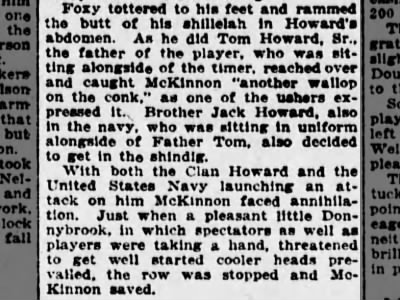
Tom wasn’t just a player. He wasn’t just a coach. He was a fan of the game, especially when his sons played. Both of his sons joined the Navy Reserve and played for the Boston Yard team. Well, an account of a game between The Wanderers (of New York) and the Boston Yard Team highlighted how hockey was a family affair, even if they were in the stands.

Hockey fights are family affairs for the HowardsHockey fights are family affairs for the Howards Tue, Feb 19, 1918 – Page 15 · New York Herald (New York, New York) · Newspapers.com

For each major change in hockey in the teens and twenties, people consulte Tom or his Almanac. Whether it was the transition from seven to six man squads or amateur over pros, newspapers sought Tom’s opinion. Additionally, Tom supported his wife as she coached the St. Nicholas Blues, a women’s hockey team.

Tom retires around 1927 and moves to Los Angeles with his son, Tom Jr. The last note in a long, storied life came from The Winnipeg Tribune:

Toms obitToms obit Fri, Nov 30, 1945 – Page 5 · The Winnipeg Tribune (Winnipeg, Manitoba, Canada) · Newspapers.com

Tom’s Wife, Kathleen, lived on until 1967. Tom’s kids, well, more on them later because Tom’s story doesn’t end here.

Interlude: Hobey Baker – American Football, Hockey, and War Hero

In a bit of controversy, superstition, and ill-advised actions, Hobart “Hobey” Baker joined the ranks of America’s fallen.  On Dec 21, 1918, Baker launched in a newly repaired Spad for a flight test. The Spad wasn’t his normal plane. He received demobilization orders, and this was his final evening with squadron. He was going out “for one final ride.” With all the hallmarks tragedy in place, Baker died from injuries sustained from the plane crash.

Long before Hobey graced the skies over France, he was Princeton’s football and hockey star. Here is an excerpt from The Brooklyn Daily Eagle on January 23, 1911:

Columbia, under Tom Howard, loses to Princeton with Hobey Baker in his freshman yearColumbia, under Tom Howard, loses to Princeton with Hobey Baker in his freshman year Tue, Jan 23, 1912 – Page 15 · The Brooklyn Daily Eagle (Brooklyn, New York) · Newspapers.com

This was Hobey’s freshman year at Princeton. It was also Tom “Attie” Howard’s first year of coaching at Columbia. After college, Hobey played for the St. Nick’s Athletic Club in the amateur hockey league. As a result, Hobey and Attie crossed paths many times over the years.

Hobey Baker joining the aviation corps garnered some of the biggest headlines in 1916. Additionally, Hobey moved to Philadelphia and played hockey for the Quaker City club by Dec 1916. Despite all that, the Canadian Club asked Hobey Baker to play for their team in a charity match. Hobey accepted and was the only American on a Canadian rock star team.

Wed, Mar 21, 1917 – Page 20 · The Brooklyn Daily Eagle (Brooklyn, New York) · Newspapers.com

By all accounts, Hobey Baker was the quintessential American sports hero. Furthermore, he became a hero in France earning a Croix de Guerre. Even though he died by his own actions after the war, I’m taking the time remember an American hero. One of many.

https://www.hobeybaker.com/

Source:
1. A Flame that Bured too Brightly: Hobey Baker. Fimrite, Ron. Sports Illustrated. August 20, 2014. https://www.si.com/college-football/2014/08/20/hobey-baker-si-60-ron-fimrite

The CMPC in New York

As previously stated, the CMPC’s primary mission was to enforce conscription. In New York, the first head of station ensured that the media, and the American public, believed his mission was broader. The British Assistant Provost Marshal meant to apprehend fakers, deserters and other “undesirables”. That first head of station was Lt. Col Frederick Fraser Hunter, who arrived in March, 1918.

The British Assistant Provost Marshal (B.A.P.M) headquarters was located near Battery Park, New York City with 50 personnel assigned. This placed the headquarters well south of the BCMR’s main office on 681 fifth avenue, but within easy reach of the main recruiting office on 280 Broadway. Canada and Britian split funding for the B.A.P.M. Additionally, USA, Canada and Britian entered into a tri-party agreement on authorities. The B.A.P.M was the first foreign law enforcement authorized to operate in the United States. Moreso, the United States supported and assisted the B.A.P.M.

From various newspaper articles, The B.A.P.M prosecuted at least four cases. One case involved two Americans who volunteered for the Royal Canadian Air Corps. They were declared deserters when they returned to Viriginia after the dissolution of the Air Corps in 1916. (Note: The Air Corps was reconstituted in 1917.) However, most of the cases were fakers.

Fakers posed as British officers with great military deeds and attempted to cash large cheques from Canadian banks. Usually, the faker would get a free meal, a free night’s stay, and some of the cash. The newspapers ran a few stories about these fakers and how they were caught by the B.A.P.M.

As for Col. Hunter, he led a storied and controversial life. Born in 1876 in Dunham, Ontario, Canada, he traveled the world in service of the empire. Hunter earned distinction during his survey mission in India and during his time with the South Perisan Rifles. Because of his Canadian background, he was the B.A.P.M. until April, 1919 when most of Canada’s war aparatuses were dismantled.

In 1919, the B.A.P.M. transitioned from Canadian to British hands. Besides the name change to British Army Provost Marshal, the replacement head of mission became Col. Norman G. Thwaites. Oddly enough, his courtship and marriage to Elleanor Whitridge Greenough made significant news. Unfortunately, not much appears to have been written about the B.A.P.M. under his direction.

The CMPC office in New York requires more research. Considering LtCol Hunter traveled most of the eastern seaboard of the United States, a question lingers about his true purpose. Additionally, what was the effectiveness of the New York office. Exact numbers on prosecutions were not listed in the Report on enforcement of the Military Service Act (MSA). However, the report on the Overseas Mission explicitly called out the MSA enforcement numbers as unverifiable. As result, I am unable to confidently determine the effectiveness or exact mission of the B.A.P.M. and Lt Col Fraser Hunter.

To note, Col Fraser died in Dunham, Ontario in 1959. Itt appears he married a Kate Upper in New York around 1903. More of his story can be found in the book “Kipling’s Canadian: Colonel Fraser Hunter, MPP, maverick soldier surveyor in ‘the Great Game'”.

Read More

Interlude: Winnipeg’s Forgotten Hockey Royalty, the Howards

Attempting to repeat 1895, the Winnipeg Jets are trying to upset strong favorites in order to win the 2018 Stanley Cup. In Dec 1895, the Winnipeg Victorias amateur hockey club bested Montreal to secure the cup with a team that became known as “the Winnipeg Seven”. While some fame befell the Winnipeg Seven, Thomas Acheson “Attie” Howard stands out due to his very publicized move to Yale. However, hockey was a family affair for the Howards.

While Thomas Howard’s journey started in 1871, not much was able to be discovered about his early years. Tom’s first appearance is an unassuming marriage announcement to Kathleen Cronn in the May 1893 edition of the Winnipeg Tribune. A couple of years later, Thomas Howard, Jr. came into the world in 1895. Finally, Jack T. Howard completed hockey’s royal family in 1897.

The list of Tom’s accomplishments only started with winning Lord Stanley’s “Challenge Cup” in Dec 1895. In 1899, Tom agreed to become Yale’s head coach of Men’s Ice Hockey. In the 20’s, he joined Spalding to sell sticks and become the editor of Spalding Official Ice Hockey Guide, an almanac on hockey and winter sports. By 1927, Tom and Kathleen retired to Tom Jr’s place in Los Angeles. A lone obituary in the Winnipeg Tribune on 30 Nov, 1945 noted the passing of Tom “Attie” Howard on the 18th. But, this wouldn’t be a story on family if it was only about Tom.

In New York City, Kathleen Howard came into her own as possibly hockey’s first female coach. Noted as “Mrs. Tom Howard” in most newspaper articles, she argued that hockey was for women. Mrs. Howard clearly coached the St. Nick’s Reds throughout the teens. It’s not clear when things changed.

In April 1918, Kathleen organized a hockey match between St. Nick’s and a Boston team with all proceeds going to the employees of the Brooklyn Ice Palace. The Brooklyn Ice Palace created ice using a mechanical process and ammonia. A State Ice Controller ordered the ice rink to close to save materials for the war effort. While the Brooklyn Ice Palace eventually reopened and the St. Nick’s Reds started playing again, Mrs. Howard seemed to fade into the background. She moved to California with her husband and passed away in 1954.

Newspapers gushed over Tom and Kathleen’s kids, Tom Jr. and Jack. From all accounts, Tom limited Junior’s playing due to a possible heart condition. When Tom Jr played, commentators praised his ability. Unfortunately, few articles mention Jack. One of Jack’s last mentions was in an article about how he and his brother played for a Boston amateur team in the mid-20s.

In the midst of the twenties, Tom Jr. married Natalie Matthews. They eventually move to Los Angeles, where they end up taking care of their parents. Tom H. Howard possibly passes away in the 60s, but Natalie lived until 92 (1987).

This only touched upon highlights of, possibly, the first royal family of hockey. Most amazingly is the story of Kathleen Howard. She brought the tradition of women’s hockey from Canada to New York City and Boston. She started a team and organized games. She, quite possibly, was the first female hockey coach in the United States.

Unfortunately, deep mysteries abound. What happened to Jack/John T Howard after Boston? Did Tom Jr. and Natalie have children? For now, the Winnipeg Jets have a chance again to go for the Cup, and recreate the magic of the 1895 Winnipeg Victorias.

Interlude: Women’s Hockey during the Great War

While looking for more information on professional hockey players who served in WWI, a New York Times article on Girl’s hockey was buried in the search results. The article, “Girl’s hockey in brooklyn tonight”, stated that Mrs. Tom Howard would lead an exhibition game and other activities in support of the Ice Rink’s (Brooklyn Ice Palace) employees. The game occurred on April 13th, 1917.  The rink closed on the 14th. Although the news article didn’t explain, a Brooklyn Library blogger stated the rink was ordered to shut down to save on ammonia, which is used in creating artificial ice and munitions. But the information begged a bigger question. Who is Mrs. Tom Howard and How popular was women’s hockey in WWI.

As the NHL was finishing its century of hockey, women’s hockey is starting to pick back up. again. In honor of the WNHL, The Bustle published a great high level history of women’s hockey. For a more detailed look, Lynda Baril published a great book on women’s hockey in Quebec. And, Andrew Holman detailed the issues surrounding women’s hockey in 1920s. Currently, the Canadian Women’s Hockey  League (CWHL) and National Women’s Hockey Leage (NWHL) pay their players harkening back to the early 1900s.

Going back to the first question, Mrs. Thomas A. Howard hasn’t revealed herself, yet. Thomas Acheson “Attie” Howard is fairly well documented. A Stanley Cup winner with the Winnipeg Victorias, he moved to New York in 1899. He eventually ended up endorsing a hockey stick and writing a book on hockey and winter sports for Spaulding Co. He had two son, Thomas Jr. and Jack. Finally, he died in Los Angeles in 1945. In all of the documentation reviewed, there is only a “Howard, wife” (1920 New York Census) or Mrs. Thomas A. Howard (NYT, April 13 1917). Even his death certificate doesn’t list his wife or sons. For now, the mystery of Mrs. Thomas A. Howard remains. Hopefully, I’ll learn more about women’s hockey in uncovering her identity.

Background Reading:
1. Women’s National Hockey League: https://www.nwhl.zone/
2. Canadian Women’s Hockey League: http://www.thecwhl.com/
3. https://www.bustle.com/articles/115804-the-history-of-womens-ice-hockey-is-long-full-of-even-longer-skirts-heres

Read More

The British Canadian Recruiting Mission

The British Canadian Recruiting Mission (BCRM) operated under the British War Office (abbreviated WO or W.O. in personnel records). The War Office was also known as the British War Mission. The BCRM was created to recruit British subjects in the United States for service in the C.E.F. However, the BCRM was only one component of the War Office.

The BCRM spread across the U.S.A, but the focus is on New York City. Based upon a few sources, the BCRM in NYC consisted at least ten personnel with two primary offices. The following personnel were assigned or connected to the BCRM:

  • B.Gen Wilfred Arthur White. A British General associated with the Connaught Rangers
  • LtCol Cameron Alex Warren: Canadian. Chief Medical Examiner
  • LtCol Campbell Arthur Stuart: French-Canadian. Military Secretary. Connaught Rangers
  • Capt Paul FleetFord Sise: Canadian. Director of Recruiting. Hon. Major.
  • Capt Francis Chattan Stephens: Canadian.
  • Capt Alexander Cunningham Tweedie: Canadian.
  • Lt. Frederick Albert Gunther: British.
  • Lt Thomas Edward Allen: Irish
  • J.W. Woods: Canadian. Civilian. Director of Purchasing
  • George Algernon Trenholme: French-Canadian. Civilian. Audit and Finance

While there are two primary locations, some locations are still being validated. Here are the locations:

  • 681 Fifth Avenue: Suspected to be BCRM and War Office HQ.
  • 280 Broadway: BCRM Recruiting station
  • 511 Fifth Avenue: Unverified location
  • 120 Broadway: Unverified location. Possibly purchasing offices.
  • Vanderbilt Hotel: a location listed for Capt Paul SISE. Unverified association to BRMC

So, here’s the real teaser. The BCRM was home to a CMPC Assistant Provost Marshal (APM) who was in charge of about 50 personnel. I don’t think this included the Royal Flying Corps APM and three subordinates for NYC. There’s clearly more to this story. For example, there’s an interesting New York Times article from 1918 on the Provost Marshal office. However, this APM is in direct support to the BCRM with authorization to enforce the Military Service Act, 1917.

Sources:
1. Who’s Who in the British War Mission in the United States of America, 1917 (Google Book: https://tinyurl.com/y9ohlt8n)
2. Richard Holt (2015) “British Blood Calls British Blood The British-Canadian Recruiting Mission of 1917-1918,” Canadian Military History: Vol. 22: Iss. 1, Article 4. Available at: http://scholars.wlu.ca/cmh/vol22/iss1/4
3. Library Archive Canada CEF record for Cameron Alexander Warren (RG 150, Accession 1992-93/166, Box 10104 – 1): http://www.bac-lac.gc.ca/eng/discover/military-heritage/first-world-war/personnel-records/Pages/item.aspx?IdNumber=298860
4. Library Archive Canada CEF record for Campbell Arthur Stuart (RG 150, Accession 1992-93/166, Box 9393 – 20): http://www.bac-lac.gc.ca/eng/discover/military-heritage/first-world-war/personnel-records/Pages/item.aspx?IdNumber=256894
5. Library Archive Canada CEF record for Francis Chattan Stephens (RG 150, Accession 1992-93/166, Box 9272 – 22): http://www.bac-lac.gc.ca/eng/discover/military-heritage/first-world-war/personnel-records/Pages/item.aspx?IdNumber=250011
6. Library Archive Canada CEF record for Alex Cunningham Tweedie (RG 150, Accession 1992-93/166, Box 9855 – 10): http://www.bac-lac.gc.ca/eng/discover/military-heritage/first-world-war/personnel-records/Pages/item.aspx?IdNumber=282067
7. Library Archive Canada CEF record for Paul Fleetford Sise (RG 150, Accession 1992-93/166, Box 8952 – 28):http://www.bac-lac.gc.ca/eng/discover/military-heritage/first-world-war/personnel-records/Pages/item.aspx?IdNumber=232053
8. Expense of Assistance of Provost Marshal in New York to be divided between the British and Canadian Governments (RG24-C-1-a. Volume/box number: 1008. File number: HQ-54-21-23-116): http://www.bac-lac.gc.ca/eng/CollectionSearch/Pages/record.aspx?app=fonandcol&IdNumber=1886766

Additional Sources:
1. Caledonian Vol 18 (Google Book: https://tinyurl.com/ycemq8gy)

Interlude: Hockey Goes to War

While I’m chasing down information related to CMPC locations, personnel and operations, I ran across an interesting topic Hockey and the Canadian military. The trigger was statement lamenting the inability to play hockey in the rear areas of the Great War. Unfortunately, I’ve seem to have lost the reference. However, I’ve found some other interesting articles about hockey, Canada,and WWI.

For Canada, many hockey players entered the ranks of the Canadian military. So much so, Canada created the “Memorial Cup” to remember those who served. The “Memorial Cup” is awarded to the junior hockey champions in the Canadian Hockey League.

Hockey is so integral to Canadians that the 148th Battalion ran two recruiting posters featuring hockey. (NOTE: I have no statistics to determine the success of the posters.) Additionally, Canadians played hockey while interned in Switzerland.

Finally, as Canada was dismantling from WWI, the Royal Military College requested 2000 (CAD) to refit two aviation hangers for hockey. The Privy Council issued Order of Council 1919-2040 to authorize it.

There is more to this story. JJ Wilson, CBC, and others have delved into greater detail. Canada’s Veterans Affairs even created a lesson plan to raise awareness on the close relationship between Hockey, the Canadian military and remembering those hockey players who’ve died in the line of duty.

Sources:
1. http://www.veterans.gc.ca/eng/remembrance/those-who-served/hockey-canadian-military
2. http://www.veterans.gc.ca/eng/remembrance/those-who-served/hockey-canadian-military/history
3. JJ Wilson (2007) Skating to Armageddon: Canada, Hockey and the First World War, The International Journal of the History of Sport, 22:3, 315-343, DOI: 10.1080/09523360500048746
4. List of Recruiting Posters: http://www.nysl.nysed.gov/msscfa/sc23360-canada-recruit.htm
5. Order of Council 1919-2040: http://central.bac-lac.gc.ca/.redirect?app=ordincou&id=386631&lang=eng
6. Image of Canadian hockey team, Switzerland 1917: http://central.bac-lac.gc.ca/.redirect?app=fonandcol&id=3386118&lang=eng

Additional Sources:
1. http://www.cbc.ca/news/canada/toronto/hockey-and-the-first-world-war-1.2831318
2. 148th Battalion Recruitig poster: https://www.pinterest.com/pin/170081323398051922/
3. 148th Battalion Recruitig poster: https://www.pinterest.com/pin/170081323398051922/

Royal Canadian Navy Police: Quick Note

In my last post, I didn’t include any information about the Royal Canadian Navy (RCN) Naval Police (N.P.)/Shore Patrol. While I found some information on MP Museum’s website, I wanted more detailed information and get at source documentation.

Anita Draper posted personal letters from Noah Draper. One letter dated 29 December, 1916, highlighted that the Naval Police had a censorship and/or Counter-Intelligence function.

A web site dedicated Canadian Military Police (NOTE: the redcap website) indicated that the RCN, likely during WWII, relied upon dockyard police, local civil authorities and shore patrol. MP Museum does back this up and provide more details on who had RCN policing functions. With associations with the Director of Naval Intelligence, Naval Provost Marshal and a mix of other, I think that gaining an understanding of the WWI RCN NP will be an arduous task.

Sources:
1. http://mpmuseum.org/rcn.html
2. http://www.anitamaedraper.com/author-memories/ww1-letters-home-dec-29-1916
3. WWII RCN Police information: http://home.mweb.co.za/re/redcap/canada.htm
4. Draper, Noah: https://www.bac-lac.gc.ca/eng/discover/military-heritage/royal-canadian-navy-1910-1941-ledger-sheets/Pages/item.aspx?IdNumber=12966&