The NAHL: Cornelius Fellowes Jr.

A rebellious Cornelius Fellowes Jr. hid an unrestrained private life within a very boisterous public life. Descendant from colonial family lines, Cornelius entered into his father’s business, horse racing, possibly more from envy than following tradition. When Cornelius Sr. found out about the marriage to Nathalie Rogers, Senior disinherited Junior and cut off all support. As if in an American fairy tale, Nathalie, and by extension Cornelius Jr., inherited a quarter of million dollars from a deceased uncle in Paris. The unreported marriage, disavowal and windfall  were just the start of Cornelius’ tumultuous adult life.

Cornelius Fellowes Jr. was born to a horse racing magnate in Brooklyn, 1879. Cornelius came into adulthood with a true love, news story that was more about the senior socialite than the son. Written as a socialite intrigue piece, Cornelius quietly eloped with Nathalie Rogers, the daughter of a Philadelphia merchant, “over a year ago” as of June 1900. Between a secretive marriage and possibly acquiring goods under false pretense, Senior disowned Cornelius in June 1900. Fortunately, the death of an uncle depraves Cornelius Senior from punishing his son. True love trumps over money and arranged marriage. But, this isn’t the end of this story.

The article hints at an indecent indiscretion of Young Fellowes. While only hinted at, Cornelius probably got married around 1895 or 1896 at the age of 16 or 17. Nathalie would have been approximately 14 or 15, and quite possibly with their first child, William Fellowes. Although 16 is too young for 1890s New York, it is the legal age for Pennsylvania. When the story was published, Cornelius fathered three children with Nathalie, William, Gertrude, and Celia. The lack of documentation and abbreviating his name for the 1905 census demonstrates Cornelius’ efforts to separate his private life from his public profile.

To reinforce the concept, Cornelius’ divorce and remarriage lacked documentation just like his marriage to Nathalie. When reporters inquired Mademoiselle (mlle) Dazie about her marriage, she remarked that friends knew, but was surprised that the news had not leaked out before. The article from the Brooklyn Daily Eagle posted in March 1914. Unlike with Nathalie, no records seem to exist that indicate children between Cornelius and Dazie. Until about 1920, reporters detailed Cornelius Fellowes’ bankruptcies, various dealings and even a suspicious death. Afterwards, the news seem to focus solely on his sporting enterprises. When he passes in August 1957, a small blurb in the New York Times reminds us of how he failed to secure  the great horse “Man o’ War” by a hundred dollars.

Despite all the high profile drama, Cornelius Fellowes Jr. played a significant role in the National Amateur Hockey League. For starters, he sponsored the Fellowes Challenge Cup. That cup symbolized the U.S. national amateur hockey champions until 1926. He managed the St. Nicholas Rink from 1905 until 1920. Additionally, he ran the Wanderers of New York. As a rink and team owner, he was a hand behind the professional as amateurs in that role. Between Cornelius, George Brown, and Roy Schooley, they would forge a hockey powerhouse that would carry to two Olympic silver medals and rival even the Canadian teams.

Research notes:
– Cornelius Fellowes was written as Col. Fellowes on  the 1905 New York Census and  Fellows in some U.S. Government documents and newspaper accounts
– Nathalie Rogers was written as Natalie in some U.S. Government documents and newspaper accounts
– Celia was also written as Consuelo on Census documents
– Mlle Dazie falls prey to the multitude of spellings.

Sources:
1. Ancestry.com. Colonial Families of the USA, 1607-1775 [database on-line]. Lehi, UT, USA: Ancestry.com Operations, Inc., 2016. This collection was indexed by Ancestry World Archives Project contributors.
2. The Evening World, New York, New York  09 Jun 1900, Sat  •  Page 5
3. New York State Archives; Albany, New York; State Population Census Schedules, 1905; Election District: A.D. 07 E.D. 37; City: Brooklyn; County: Kings; Page: 63. Courtesy of Ancestry.com
4. The Brooklyn Daily Eagle Brooklyn, New York 21 Mar 1914, Sat  •  Page 16
5. Brian McFarlane, Golden Oldies: Stories of Hockey’s Heros, 2015
6.
Cornelius Fellowes, Sportsman, 78, Dies; Lost Bid for Man o’ War by $100 in 1918. (1957). New York Times (1923-Current File), p. 15.

The NAHL: CAPT William Rees Rush

At the start of 1917, Captain William Rees Rush commanded the Navy Yard in Boston and commandant of the First Naval District. He held the position since November, 1914. Although he officially retired on October 16, 1916, the Navy recalled him on October 17, 1916 to continue at Commander, Navy Yard, Boston. The Navy detached him from duty as Commander, First Naval District on February 7, 1918, but retained him as Commandant, Navy Yard. Finally, they retired Captain Rush on March 1919 upon being relieved of duty.  As Commandant, he oversaw many aspects of the Navy Yard and the transition to war. Besides reports of suspicious personnel or fires, he hired George Brown to be the athletic director for the First Naval District and promoted sports. For example, the Y.M.C.A built the first recreational facilities at the Navy Yard under his command. However, this is a small section of Captain Rush’s 43 year career in the United States Navy. And, it is not even the most significant time of his career.

Born in Philadelphia on September 19, 1857, William entered the U.S. Navy as a midshipman in June, 1872. This was not a Naval Academy midshipman appointment. William experienced a more “traditional” navy officer’s education. It lasted nearly ten years until his promotion to ensign in October, 1881.

Officer promotion worked completely different during Captain Rush’s service than now. Currently, promotions from ensign to lieutenant (junior grade) (LTJG) and LTJG to lieutenant (LT) are each two years with a minor review of the officer’s service record. William was promoted to LTJG in February, 1889 and promoted to LT in December, 1893. Ensign to LTJG was eight years and LTJG to LT was only four years. Plus, there were examinations. However, it is difficult to find much information without digging through the Bureau of Navigation or Personnel archives.

After several years at LT, William attended the Navy’s War College in 1900. This duty assignment prepared William for promotion to lieutenant commander (LCDR) in 1901. He also married Jane Pomroy Hare while attending the War College. There’s nearly a month of leave probably because Jane and William married in Hawaii.

In 1909, William was promoted to captain (CAPT). In December 1913, he attached to the Florida (BB-30). In April 1914, BB-30 and CAPT Rush were order to Vera Cruz as part of a expedition to evict General Victoriano Huerta from the Mexican presidency after a coup d’état. Between 21 and 22 April, CAPT Rush led a naval brigade (about 1,600 men) to take Vera Cruz. In about 24 hours, the city was captured with 17 dead and 65 wounded. In December, 1915, CAPT Rush was awarded the Medal of Honor.

After WWI, CAPT Rush and Jane Hare traveled Europe. Eventually, they landed up in Pallanza, Italy. CAPT Rush died on August 2, 1940, just after the fall of France. Jane Hare passes away in Switzerland on August 27, 1947.

As Commandant of the First Naval District, CAPT William Rush promoted sports and competition. It wasn’t limited to hockey, but football and other sports as well. He hired one of the best sports promoters of the era, and likely had a hand in acquiring talent, too. Whether for public relations or a competition against the Second Naval District or concern for the health of sailors, I doubt we’ll ever know. May be it was all three. Without Rush’s appointment of George Brown, we might not have had the first united states hockey league of national preeminence, the United States Amateur Hockey Association.

Sources:
1. https://www.history.navy.mil/research/library/online-reading-room/title-list-alphabetically/l/living-conditions-in-the-19th-century-us-navy.html
2. Naval Officer’s Service Record Abstract, National Archives, courtesy of Fold3 (https://www.fold3.com/image/581042150)
3. Confidential War Diaries (of the First Naval District) (1917-1918), National Archives, https://catalog.archives.gov/id/1137572
4. https://en.wikipedia.org/wiki/William_R._Rush
5. https://en.wikipedia.org/wiki/USS_William_R._Rush_(DD-714)
6. https://en.wikipedia.org/wiki/USS_Florida_(BB-30)
7. https://www.usni.org/magazines/naval-history-magazine/2014/march/take-veracruz-once
8. https://history.army.mil/html/moh/mohmex.html#RUSH

The NAHL: George V. Brown

In late 1917, George V. Brown added a new role to his accomplished list, Athletic Director of the First Naval District. Prior to this, he held the same position of the Boston Athletic Association (BAA). With the BAA, he started every Boston Marathon except for the first two. During his era, BAA teams won championships. He promoted sports whenever he got the chance. George was such a fixture in the BAA and Boston sports that the BAA suspended or refocused operations during 1918.

It is hard to tell who used whom. The U.S. Navy leveraged George’s sports promotions to increase its popularity. Quite possibly, the First Naval District hoped to gain an advantage in the regular sports competitions against Second Naval District (Newport, Rhode Island) and others. For George, he became responsible for Navy sports across most of New England.

Following the war, George returned the BAA back to its normal sports operations. A long time member of the U.S. Olympic Committee, George built the U.S. Olympic men’s hockey team for the first Winter Olympics in 1924. (NOTE: Cornelius Fellowes created the first Olympic men’s hockey team in 1920.) It was a silver medal team consisting of Herb Drury and Alphonse La Croix.

George also experienced change in hockey from the amateur to the professional. While George supported professional hockey, George believed in the amateur spirit. He tried several times to establish a new amateur league in the Boston after the break up of the US Amateur Hockey Association. In 1932, the Boston Globe commented about George’s efforts to “breathe new life into the amateur hockey corpse.” Despite a potentially 150 registered clubs with the Amateur Athletics Union (AAU), amateur hockey would never regain a prominent role.

Fri, Dec 23, 1932 – 16 · The Boston Globe (Boston, Massachusetts) · Newspapers.com

Sources:
1. https://www.baa.org/
2. https://en.wikipedia.org/wiki/George_V._Brown
3. Boston Globe, December 23, 1932, courtesy of newspapers.com, https://www.newspapers.com/clip/31905965/
4. Los Angeles Times, March 8, 1931, courtesy of newspapers.com, https://www.newspapers.com/clip/29383315/

The NAHL: 1917, Hockey’s Year of Reckoning

On the eve of WWI, a medal of honor awardee, prominent sports personalities and the best hockeyists in the United States gathered on a world stage.  A legend had been building since the early 1900s starting in the New York City area. That legend, the legend of amateur hockey, came to fruition in 1917. The foundation for the next decade of hockey, both professional and amateur, were laid in that fateful year.

This blog over the next few months will provide brief biographies on key characters. Knowledge known and forgotten will be here in an attempt to provide a more complete picture of the hockeyists and their managers.

To note, amateur hockeyists can’t be paid for playing hockey. So, what were their jobs? Some times, they worked for a sporting goods store, like A. G. Spalding. Other times, they worked as car mechanics. And, as Brian McFarlane discovered, their work really was hockey and not lacing footballs at Spalding [1].

Getting back to the main topic, many will hopefully recognize the key players. From Boston, George V. Brown, Raymie Skilton and Frank Synott will be documented. From the US Navy, CAPT. William R. Rush, who was awarded the Medal of Honor for actions at Veracruz [2], plays a role. From Pittsburgh, Roy Schooley, Herbert Drury and the McCormick brothers drive action. Finally, New York’s Mickey Roach and “Duke” Wellington will be outlined. And, yes, Mickey Roach used be a Bostonian.

1917-18 season was a disruptive season for hockey. The creation of the National Hockey League, the infamous Montreal Arena fire [3], and the politics of amateur vs professional hockey that built to a crescendo in that season. The larger than life personalities, the hockeyists and the organizations all vying for control of the final outcome. But, first, we need to know who the entities are, and I hope you enjoy the journey.

Sources:
1. https://www.amazon.com/Golden-Oldies-Stories-Hockeys-Heroes/dp/1770412506
2. https://en.wikipedia.org/wiki/William_R._Rush
3. https://en.wikipedia.org/wiki/Montreal_Arena

Interlude: Winnipeg’s Forgotten Hockey Royalty, heir apparent Thomas Henry Howard

Despite being a first son of hockey, Thomas Henry Howard left surprisingly few markers resulting in a confusing trail across the ledgers of history. Born in Winnipeg, Manitoba, he really grew up in Brooklyn. As a result, Tom Jr. was actually more of Brooklynite than a Winnipegger. When Canadian and American WW1 demands threatened to ensnarl the Howards, Tom chose his fate by joining the United States Navy Reserve Force. While in the USNRF, Tom played hockey for Charlestown Navy Yard in Boston. In all the numerous teams, leagues, and travel, Tom wins his own hockey championship in the California Cal-Pro league in 1930 with the Shell Oil Tigers. Unfortunately, few trail markers remain after 1930 until his death in 1971. Regardless of how his trail meandered, he exemplified, “Family above all.”

Tom Jr. was raised at the table of winter sports. Tom Sr. won the Stanley Cup and reinvented himself in New York and Pittsburgh. Kathleen taught skating in Winnipeg and New York. She possibly taught young Jack how to speed skate. Not to mention, Winnipeg newspaper noted her gracefulness at various winter galas of her youth. But, Tom Jr. seemed to desire a more subdued life.

In many respects, Tom’s father hints at managing his sons like hockey players. Tom Jr. appears to start referring during the 1912-1913 season. Then, Tom moves to playing in the 1913-1914 season. However, news coverage seems to increase when Jack matures into amateur hockey by 1916. At this time, everyone is reading about WWI, and the Howards are still Canadian and subjects of the King of England.

Looking at the available facts, Tom joined the USNRF in Newport, Rhode Island in part due to patriotic pride for the United States. Additionally, other reasons may have influenced Tom Jr’s and Jack’s decisions to join the USNRF. Regardless of the motivation, Tom played in the USN hockey league for the Newport (R.I.) and Charlestown (Boston) Navy Yards. The US Navy trained Tom to play with mines. Tom and his brother, Jack, was assigned to the U.S.S. Canandaigua. They possibly particpated in the North Sea mine barrage. Whether they went with the fleet, Tom referred a Brookleny high school hockey game on 11 Jan, 1919.

After the death of his brother Jack in Dec 1919, Tom moved to California and married Natalie Matthews. Listing a California home address, Tom Jr. continued to play for his father’s teams on the East Coast from 1920 until 1924. During the late-twenties, he played for a variety of teams until landing on the 1930 Shell Oil Tigers team. Under Ernie Miller, the Shell Oil Tigers team beat the Vancouver Ballards to secure the CalPro championship. In 1949, Los Angeles Monarchs honored Tom Howard Jr and four others for bringing hockey to California. All the while, Tom and Natalie ensured the care of their parents.

From census records, Natalie’s father and then Tom’s parents lived with them in California. Natalie’s father moved from New York to be recorded in a 1920 California Census. When the next census happened in 1930, Tom’s parents, Tom Sr. and Kathleen, had moved in. From all the travels between New York and California, Tom Jr. appears to have supported his family’s decisions and supported the decisions of the family he married. As a result, it appears that he believed in family above all else.

the 1949’s tribute is really the last easy marker that Tom and Natalie Howard leave. A phone book entry here or may be a property records there. Tom died in Denver, Co. in 1971 and Natalie died in June of 1986. They died childless. Thus, with their deaths, ended the line of hockey greats.

Sources:
1. Manitoba Vital Statistics Agency, Birth Record: 1894-002467, http://vitalstats.gov.mb.ca/Query.php, last accessed 12 Aug 2018
2. The New York Times, Sunday, January 26, 1913 pg 69, courtesy of newspapers.com
3. Hartford Courant Thursday, March 5, 1914 pg 16, courtesy of newspapers.com
4. https://en.wikipedia.org/wiki/USS_Canandaigua_(ID-1694)
5. https://en.wikipedia.org/wiki/North_Sea_Mine_Barrage
6. Brooklyn Eagle, Saturday, January 11, 1919, pg 8, courtesy of newspapers.com
7. “California, County Marriages, 1850-1952,” database with images, FamilySearch (https://familysearch.org/ark:/61903/1:1:K8FB-YBP : 8 December 2017), Thomas Henry Howard and Natalie Matthews, 19 May 1921; citing Los Angeles, California, United States, county courthouses, California; FHL microfilm 2,074,267.
8. San Bernardino County Sun (California), Wednesday, January 16, 1924, pg 9, courtesy of newspapers.com
9. Los Angeles Times, February 26, 1949, courtesy of ProQuest.
10. “United States Social Security Death Index,” database, FamilySearch (https://familysearch.org/ark:/61903/1:1:JTHC-HM7 : 19 May 2014), Thomas Howard, Nov 1977; citing U.S. Social Security Administration, Death Master File, database (Alexandria, Virginia: National Technical Information Service, ongoing).
11. “United States Social Security Death Index,” database, FamilySearch (https://familysearch.org/ark:/61903/1:1:J1B8-5YD : 20 May 2014), Natalie Howard, Mar 1987; citing U.S. Social Security Administration, Death Master File, database (Alexandria, Virginia: National Technical Information Service, ongoing).

Other Sources:

http://www.squareone.org/PolarPalace/palais.html

Interlude: Winnipeg’s Forgotten Hockey Royalty, “Young Prince” Jack

John Frederick Howard, born in Dec 1896, was probably too young to remember much about Winnipeg before the Howard’s moved to New York. However, Canada, and winter sports, never left him. He was the youngest child of hockey’s first royal family, after all.

John, often referred to as “Jack”, gained some minor fame for speed skating at St. Nicholas Rink in 1912. A competition of skill and speed between Jack and the Gerschel (or Gershel) brothers, Arthur and Stanley, from Public School 166. Unfortunately, Jack’s skating exploits don’t appear to make news until 1917. Jack may have gone to Public School 155 or 153 and Manual, now known as John Jay. So, more records may be available from “The Prospect”, Manual’s Yearbook.

In 1917, Jack joins “The Hockey Club” along with his older brother Tom Howard, Jr. The Hockey Club was one of the four amateur teams in New York’s Metropolitan League. The winner would face the winner of Boston’s amateur league. Ultimately, the Hockey Club lost the 1917 season with 2 Wins – 4 Losses. Jack played in four games with three goals and no penalty minutes. Penalties appears to be one area where Jack did not follow his brother.

After the fateful season for the Hockey Club, Jack participated in an event sponsored by the Canadian Club of New York. The event was a charity drive for the Lady Drummond Hospital fund for Canadian soldiers. Activities at the event included figure skating. But, the highlight was the hockey game between the All-Stars and the Crescent. The event took place on March 21, 1917, prior to the United States joining the war.  The entire Howard family participated in some way, and Jack’s role was Goal Umpire. The event netted $502.

By October 1917, Jack enlisted in the Navy Reserves along with his brother. They both played on the Newport Navy Yard team in the US Navy Hockey League (USNHL), which played with other amateur leagues with approval from the Amateur Athletic Union (A.A.U.). Because of the approval of the A.A.U., USNHL players had full amateur status like their Canadian cousins.

Retaining amateur status for amateur hockey players who enlisted caused much debate in Canada. Amateur hockey players, moreso than other amateur sportspeople, lead dual lives. They play hockey at night and work by day. However, that work can’t pay to play, like hockey stick endorsement. They can be hockey coaches and write books. Tom”Attie” Howard landed in some hot water with the A.A.U. over his stick endorsement. Additionally, amateur hockey was viewed as the future. In a way, maintaining status was critical. The ruling handed down as military (officer and enlisted) who were amateur hockey players were allowed to keep their amateur status.

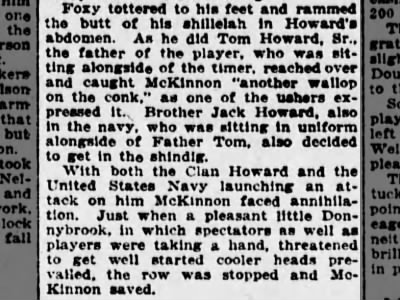
By initial accounts, Jack’s time with Newport Naval Reserves  hockey team resulted in two games and six goals. However, this is not a complete picture of the 1918 season. Jack was involved in a brawl between Charleston Navy Yard and New York Wanders’ Bill McGill. Jack, like his father who also participated in the brawl, were spectators.

Jack tragecally died after a car accident in Dec 1919. He was riding on the toolbox of Tom’s car when it was hit. Jack got up after the accident but apparently had massive internal injuries. They buried him on Christmas Eve, 1919. Jack born a hockey player; died as an insurance rep.

It’s not clear, but Jack’s death likely had a significant impact on his family. Shortly after, Press coverage of the Howard’s drastically reduces even from “home town” papers like Brooklyn Daily Eagle. Tom Jr. moves to California. While Mrs. Howard vansishes from nearly eve. I’m sure that part of the reason was the changing nature of hockey from amateur to professional and seven to six man. 1919 marks a changing in old guard of hockey.

John's deathJohn’s death Mon, Dec 22, 1919 – Page 3 · The Brooklyn Daily Eagle (Brooklyn, New York) · Newspapers.com

*NOTE: Jack is a common nickname for John in the United States. Other famous John’s named Jack include John F. Kennedy (35th President), John Lemmon (Actor), and John Lambert (NFL).
*NOTE: John Jay High School on 7th Ave was dismantled in 2004.
*NOTE: The Canadian Club of New York merged with another Canadian Society. The merged entity is called the Canadian Association of New York.
Read More

Interlude: Winnipeg’s Forgotten Hockey Royalty, “Queen” Kathleen Howard

While many aspects remain in mystery, Kathleen Howard’s advocacy for women’s hockey is unquestionable. Her abilities and circumstances paved a way for to become the United States first female hockey coach.

A Winnipeg native, she was born Kathleen Cronn or Crown in 1874. Prior to her marriage, she taught ice skating and participated in various Winnipeg Carnivals*. On May 13, 1893, she married Tom Howard, which started the “first family” of hockey. The family was complete with the birth of their two boys, Tom Jr. and John “Jack”. When they moved to Brooklyn in 1900, she brought hockey with her, and specifically for women.

Kathleen’s advocacy sprang to life in 1917 with the pronouncement, “Hockey for Women is not a Novelty.” While women played hockey in the United States during the “teens”, she noted that New York City women seemed to have forgotten about hockey. She also penned an article on women’s hockey for Spalding’s Official Ice Hockey Guide 1917, which Tom Howard edited.

Kathleen howard on hockey
Kathleen howard on hockey Thu, Feb 8, 1917 – Page 22 · The Brooklyn Daily Eagle (Brooklyn, New York) · Newspapers.com

She coached St. Nick’s women’s teams for at least two seasons, 1916-17 and 1917-18. In the 1916-1917 season, she took over for her husband in December, 1916. In 1918, she arranged a charity hockey match with Boston to help the employees after the Brooklyn Ice Palace was ordered closed. Not to say that women’s hockey died after 1918. As a matter of fact, women’s hockey enjoyed great success through the 1920s and 1930s. However, Kathleen seems to drop out of the news after 1918.

Some of this may be due to imperfect records and inconsistent reporting. For example, Manitoba lists three birth certificates for two boys, 2 for Thomas and 1 for John. Each certificate has a different name including an incorrect last name, Cronner. The Winnipeg Tribune constantly reports her last name as “Cronn” whereas government records lists “Crown”. After getting married, she is almost exclusively referred to as “Mrs. Tom Howard” or a variation thereof. As a result, a shroud of mystery wraps Kathleen. In reality, the biggest reason is due to what happened to Jack in 1919.

Somewhere around 1927, She and Tom move to California to live with their son, Tom Jr. She outlived her husband, who dies in November 1945. However, her own death is as ellusive as her legacy.

Her greatest feat wasn’t getting married to a star hockey player and coach. It wasn’t raising two upcoming stars of the amateur hockey world. Her greatest feat was being the first woman to coach hockey in the United States, and quite possibly Canada, too. Of course, Kathleen may disagree and say that seeing women in professional hockey was her greatest legacy.

*Note: Carnival events included hockey, ice skating, curling, and dressing up. Kathleen was noted for her costumes in 1891 (gypsy queen) and 1892 (faerie).

Read More

Interlude: CEF Goes to Hockey

While both Canada and United Sates militaries participated in sports before and after WWI, their participation in hockey did not emerge until recruitment impacted the amateur hockey world.

When the war started in August 1914, the Canadian military needed to modernize overnight, including raising a force. In 1914, Canada was in recession and unemployment was high. Additionally, patriotism surged amongst the general populace. As a result, there was a large willing and available manpower pool to resource units.

While notable hockey players trickled into CEF units between August, 1914 and August, 1915, a shocker came when the entire Selkirk hockey joined the 61st Battalion in September, 1915. However, this wasn’t reason why the CEF jumped into amateur hockey. It was the reason why it took off.

Richard Holt lays out how the CEF built units. In general, once a unit was authorized (or sponsored in the case of the Princess Patricia’s Canadian Light Infantry), recruiting would happen locally. The unit would also stay in garrison until initial training was complete, which was usually four months. Sports provided an outlet for those waiting for their unit to reach full strength. So, it wasn’t that the 61st waited  for hockey; hockey forced itself on to the 61st.

With the Selkirk team on hand, the 61st had a strong team and the Winnipeg leagues were voted to be playing for the Allan Cup. In the teens and twenties, the Allan Cup was possibly more popular than the Stanley Cup. One reason was that amateur hockey was more popular than professional hockey. And, The Allan Cup was for Amateurs only. As soon as newspapers reported on the 61st Battalion’s entrance to amateur hockey, other units submitted their application, including the Lord Strathcona’s Horse (Royal Canadians), the 40th Battery (Conn Smythe’s unit), the 94th Battalion (Thunder Bay) and many others. At least 24 CEF units participated in various amateur hockey leagues for the 1915-1916 season. (Note: a table of units is below.)

The 61st Battalion won the Allan Cup and defended the title throughout the 1916 season. In April, the 61st Battalion was declared the champions and shipped off to war. In addition to the 61st Battalion in the senior league, the 61st’s intermediate team won their league’s championship and the Lord Strathcona’s Horse (Royal Canadian) won the Winnipeg Central Hockey Associations’ championship title. These successes on the ice led to increased CEF participation in hockey, which led to the creation of the Military Hockey League for 1916-1917.

Nearly every CEF unit participated in the 1916-1917 season. Most (in)famously, the 228th under the McNamara brothers attempted to repeat the 61st’s success, except in the N.H.A. However, scandals and a strict adherence to deployment schedules interrupted the 228th’s chance. By 1918, the United States military supported hockey teams. Thomas “Tom” Howard Jr and John “Jack” Howard played for several U.S. Navy teams.

With the popularity of hockey in the late-teens, a lingering question remains on if the military recruited hockey players for hockey (promote support or recruitment) or war. The 228th supposedly offered Eddie Oatman $1200 to play hockey, but was unceremoniously dismissed two days prior to the 228th leaving for the front. Oatman claimed to have never been enlisted or properly enlisted. In contrast, the Howard brothers joined the Naval Reserve in 1917. Tom Jr. was passed from Newport Naval Yard to Charleston Naval Yard solely for hockey. In regards to the CEF, J.J. Wilson suggests that the CEF targeted hockey players for recruitment. While Wilson’s reasons may be contentious, it is clear the CEF appealed to hockey players to join. Captain  James Sutherland wrote an open letter and closed with the words “The whistle has sounded. Let every man play ‘the greatest game of his life’.”

Fri, Dec 31, 1915 – 12 · The Gazette (Montreal, Quebec, Canada) · Newspapers.com

Read More

Interlude: The Army Plays as Pros

In Canada and the United States, several military units created hockey teams. Most of these either played in a special military league or affiliated with an amateur league for cross-league play. However, one unit, the Toronto 228th Battalion, applied for a National Hockey Association franchise. The 228th became the first, and possibly the last, military unit with a professional sports team.

The 228th applied for franchise in September 1916 for winter 1917. At the time, hockey seasons ran from late December until March. The 228th was granted status in the NHA for the 1916-1917 season. But, this wasn’t without controversy.

Many of the players for the 228th, Northern Fusiliers, came from another NHA entity, the Torontos, aka Toronto Blueshirts. The 228th, being based in Toronto, received many of the Torontos players when they enlisted. Even before the season started the Torontos’ owner, Eddie Livingstone, filed grievances with the NHA over players. The NHA ultimately decided in favor of the 228th.

The 228th had a star-studded cast of professionals. Some went on to serve bravely. George and Howard McNamara were known as the “Dynamite Twins”. While known as powerful men on the ice, they served in the Canadian Railway Troops (CRT) in France and rose to the rank of Major. George “Goldie” Prodgers rose to Company Sergeant Major with the 6th CRT. A few were embroiled in as much turmoil as the 228th.

Gordon Meeking and Eddie Oatman created as much controversy as the 228th entering into professional sports. Gordon Meeking was more unlucky than anything else. He entered with the 228th on September, 1916; only to be discharged on February 10, 1917. It wasn’t the end of his military career. He was drafted under the Military Service Act in late 1917. Finally, Meeking was discharged as medically unfit in 1918. During his brief break in service, the NHA and the Pacific Coast Hockey Association (PCHA) bickered over whether to allow Meeking and Oatman to play.

Unlike Meeking, Eddie Oatman caused his own trouble. He started by publicly claiming he never was in the 228th. Furthermore, he claimed that the 228th owed him $800, assuming CAD, as a professional hockey player. Additionally, Livingstone claimed to have proof that Oatman was never in the 228th. Thankfully, Oatman’s service record is available from the Library and Archives Canada. He signed his attestation papers on November 1. Subsequently, he was discharged on February 10, 1917 as “not likely to become an efficient soldier”. Therefore, It is not clear, at this time, what was presented to the NHA regarding Oatman’s time with the 228th.

Meeking and Oatman represent the most public cases of the hockey players turned soldiers who left behind. NHA chose not to ban them from hockey. They were playing with the PCHA by December. However, it is not clear if the ban would have been effective. The PCHA was a separate league. Second, the NHA was collapsing and about to be replaced by the NHL.

As it transitioned overseas, the 228th broke up. This was part of the odd system of reinforcement. The major hockey players seemed to have been assigned to the Railway Troops in theater. Unfortunately, time wasn’t available to verify the full team roster or player aftermath. The McNamaras lived a long life with George passing away in 1952. But, the 228th’s transition also was a portent of NHL’s tumultuous start.

Read More

Interlude: Winnipeg’s Forgotten Hockey Royalty, “King” Attie Howard

By the end of 1930, Thomas Atcheson “Attie” Howard became one of hockey’s most important forgotten legends. During his time in the limelight, hockey drastically changed from a predominantly amateur sport to a self-sustaining professional entity. Additionally, game play drastically changed. Approved rule changes included multiple substitutions and reduction to six players on the ice. With such a storied life, a simple posting can only highlight a few major events and aspects of hockey’s King.

Thomas Howard was player, coach, and fan of hockey. Although Tom played in college, he is better known as a Winnipeg Victoria Forward. His playing career peaked with winning the Stanley Cup. Although seemingly acquired by St. Paul hockey club in 1899, Tom signed a contract to coach at Yale.

In 1900, Tom started his coaching career. In a professional capacity, Tom coached at Yale for ten years, Columbia University, Yale, Dean of Hockey at Jamaica High School,  and was possibly considered for the general manager role for the New York Americans. However, it appears Tom’s love was always amateur hockey and returned to coach the sport time and time again.

Tom wasn’t just a player. He wasn’t just a coach. He was a fan of the game, especially when his sons played. Both of his sons joined the Navy Reserve and played for the Boston Yard team. Well, an account of a game between The Wanderers (of New York) and the Boston Yard Team highlighted how hockey was a family affair, even if they were in the stands.

Hockey fights are family affairs for the HowardsHockey fights are family affairs for the Howards Tue, Feb 19, 1918 – Page 15 · New York Herald (New York, New York) · Newspapers.com

For each major change in hockey in the teens and twenties, people consulte Tom or his Almanac. Whether it was the transition from seven to six man squads or amateur over pros, newspapers sought Tom’s opinion. Additionally, Tom supported his wife as she coached the St. Nicholas Blues, a women’s hockey team.

Tom retires around 1927 and moves to Los Angeles with his son, Tom Jr. The last note in a long, storied life came from The Winnipeg Tribune:

Toms obitToms obit Fri, Nov 30, 1945 – Page 5 · The Winnipeg Tribune (Winnipeg, Manitoba, Canada) · Newspapers.com

Tom’s Wife, Kathleen, lived on until 1967. Tom’s kids, well, more on them later because Tom’s story doesn’t end here.